Detailed Guide to Expander Types: Key Differences & Uses
Which Type of Orthodontic Expander Is Right for You?
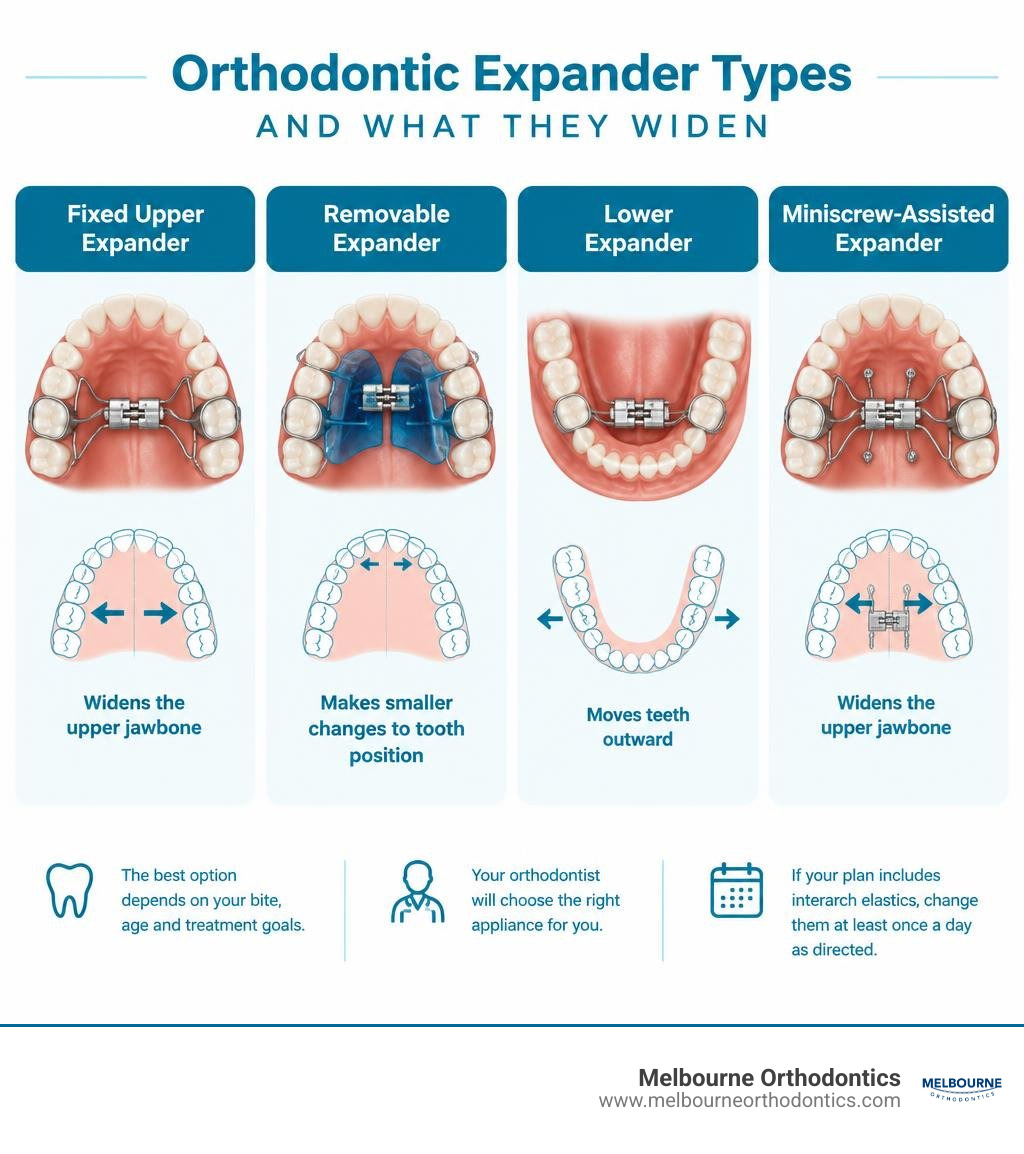
The main difference between expander types is what they widen and how they apply pressure. A fixed upper expander can widen a growing child’s upper jaw. A removable plate usually makes smaller changes to tooth position. A lower expander moves teeth outward rather than widening the lower jawbone. For some adults, a miniscrew-assisted expander may offer another way to widen the upper jaw. An orthodontist chooses the appliance based on the bite, age, and treatment goals.
Daily care also depends on the treatment plan. If your plan includes interarch elastics, change them at least once a day as directed.
I’m Dr. Chad Reddick, the orthodontist at Melbourne Orthodontics in Melbourne, Florida. My specialized orthodontic training and experience caring for children, teens, and adults inform how I assess which expander option may help each patient.
Expander vocabulary:
- miniscrew assisted rapid palatal expansion
- palatal expander before and after
- palatal expander side effects nose
What Is an Orthodontic Expander and How Does It Work?
An orthodontic expander is a custom device designed to widen a narrow dental arch or upper jawbone. When families visit us in Melbourne or Indian Harbour Beach, they are often surprised to learn that an upper jaw is not a single solid bone in childhood. Instead, it consists of two distinct halves joined down the center of the palate by a flexible cartilage line called the midpalatal suture.
By understanding the purpose of an expander, parents can see why early intervention plays such a vital role in modern orthodontic care. The appliance sits against the roof of the mouth and applies steady, lateral pressure to these two halves. Because a growing child’s body actively remodels bone tissue, this light outward force encourages new bone cells to form along the suture line, gently increasing the width of the upper jaw.

This treatment frequently forms the foundation of Phase I (early) orthodontics. The American Association of Orthodontists (AAO) recommends that children receive an initial orthodontic exam by age 7. Evaluating a child at this age allows us to spot skeletal bite discrepancies while the facial bones are still malleable, maximizing treatment options before natural growth fusion occurs.
The Biological Mechanics of Palatal Widening
To appreciate palatal expander basics, it helps to look closely at what occurs at the cellular level. When the central jackscrew on an expander is activated, it places outward mechanical tension on the anchor molars and the underlying palatal shelves.
This lateral force gently parts the left and right maxillary bones at the midpalatal suture. As the suture opens, it triggers tension osteogenesis—a natural healing response where the body produces new vascular tissue and deposits fresh bone matrix into the newly created space.
A clear sign that the skeletal suture has opened is the development of a temporary space between the top two front teeth (a midline diastema). While seeing a gap appear overnight can surprise parents, it is actually proof that the bone is widening as planned rather than just tilting the teeth.
Conditions Treated by a Palatal Expander
Orthodontic expanders correct several common dental and skeletal issues:
- Posterior Crossbites: When the upper jaw is too narrow, the top back teeth bite inside the lower teeth. An expander broadens the arch so the upper teeth rest comfortably outside the lower teeth.
- Severe Crowding: Narrow dental arches leave insufficient room for adult teeth to erupt. Expansion creates the necessary perimeter space so permanent teeth can emerge naturally.
- Impacted Canines: By widening the dental arch early, we reduce the risk of adult eyeteeth (canines) becoming trapped beneath the gums.
- Airway and Nasal Resistance: The roof of your mouth serves as the structural floor of your nasal cavity. Widening the palate expands the nasal passages, which can decrease airway resistance and support easier nasal breathing. To learn more about facial balance and airflow, read our guide on palatal expander nose side effects.
To see real-world transformations, explore what happens to your jaw before and after a palatal expander.
Major Appliance Classifications: Key Differences and Clinical Uses
Not every patient requires the exact same mechanism to achieve a healthy bite. Depending on skeletal maturity, age, and whether we need orthopedic bone remodeling or simple tooth repositioning, we turn to specialized orthodontic appliances beyond braces.
Understanding these differences helps patients appreciate why we choose specific appliances for every dental occasion.
| Expander Type | Primary Function | Patient Age Group | Placement Style | Activation Method |
|---|---|---|---|---|
| Rapid Palatal Expander (Hyrax / Haas) | Skeletal widening of the midpalatal suture | Children & pre-teens (ages 6–14) | Fixed (cemented to upper molars) | Manual key turn (once or twice daily) |
| Removable Expansion Plate (Schwartz) | Dental tipping & minor arch widening | Early mixed dentition (ages 5–9) | Removable acrylic plate | Periodic key turns by parent |
| Lower Quad Expander | Uprighting & dental expansion of lower arch | Children with primary teeth present | Fixed to lower molars | Active spring wire adjustments by orthodontist |
| MARPE (Miniscrew-Assisted RPE) | True skeletal palatal expansion | Late teens & adults (post-fusion) | Fixed with bone-anchored TADs | Specialty key activation |
Rapid Maxillary Appliances: Hyrax and Haas Systems
The Rapid Palatal Expander (RPE) remains the gold standard for correcting skeletal crossbites in growing children. The two most common designs are the Hyrax and Haas appliances.
A Hyrax expander is constructed entirely of smooth stainless steel wires and a central jackscrew, making it easy to clean. A Haas expander includes acrylic pads that rest against the palatal tissue to distribute forces across both the teeth and the palate. Both styles are fixed securely in place, usually anchored by metal bands cemented around the upper first permanent molars.
Modern technology has made these appliances more comfortable than ever. Using digital 3D intraoral scans instead of messy impressions, we design custom-fit appliances with high precision. In some cases, 3D-printed bands eliminate the need for uncomfortable rubber separators before fitting. For a closer look at how these systems work, check out our guide on using rapid palatal expanders for broader smiles.
Lower Quad Expander vs. Removable Plates
While the upper jaw can be widened skeletally along its suture line, the lower jaw (mandible) is a solid bone that fuses in infancy. Therefore, lower arch expanders work differently. A lower quad expander uses active spring arms to move and upright the lower teeth dentally, creating room for crowded adult incisors.
Timing is essential: a lower quad expander is only effective while baby molars remain present. Once all primary teeth are lost, this window for early lower expansion closes.
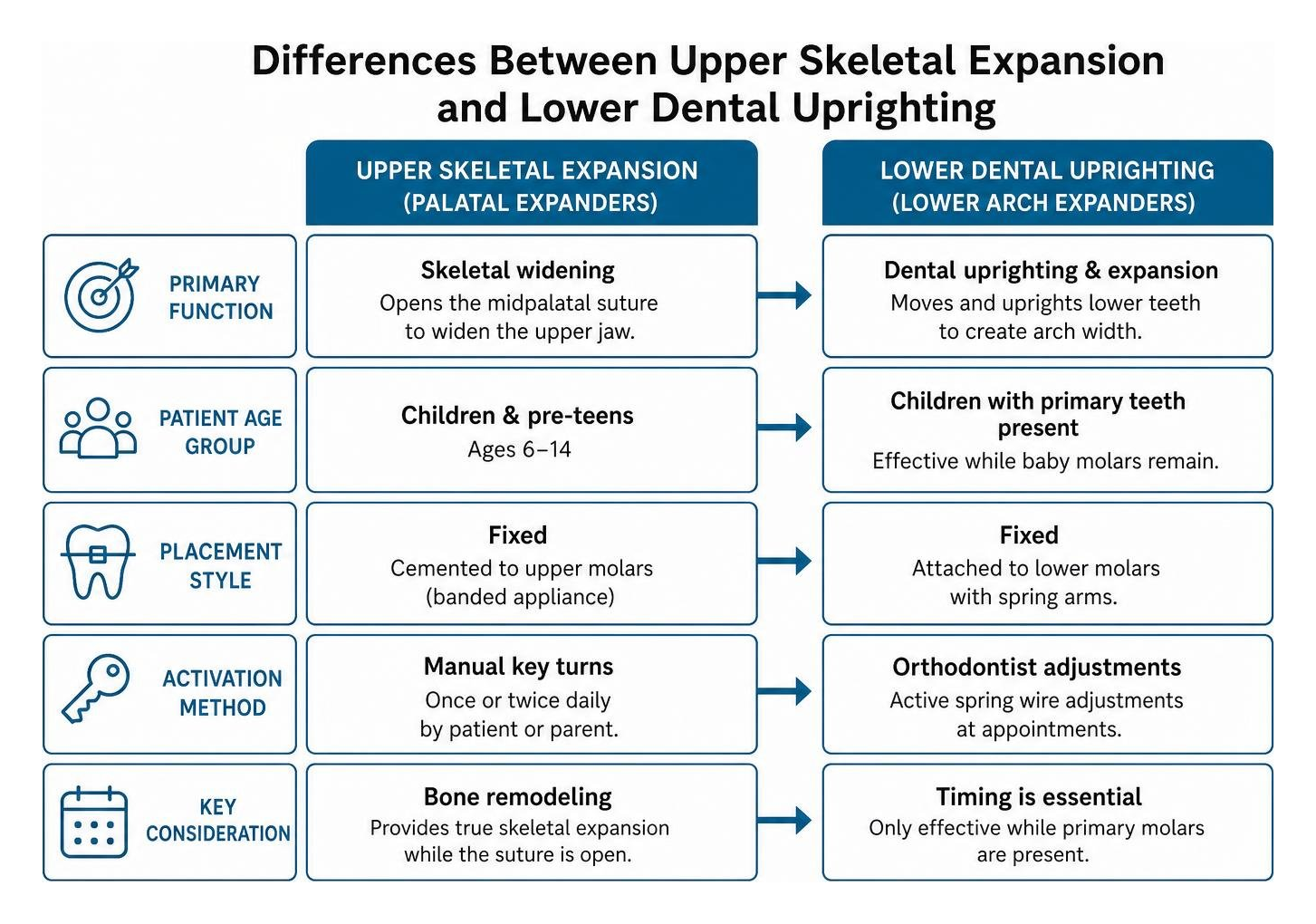
Removable expansion plates (such as a Schwartz appliance) are acrylic retainers featuring a small embedded jackscrew. They are best suited for younger children who require minor dental tipping. However, because they can be removed, success depends heavily on patient compliance. For complex space issues, we may also evaluate distal jet alternatives to move specific molars backward without relying on removable plates. Discover more about making room with expanders for a comprehensive look at space creation.
Advanced Skeletal Options: Miniscrew-Assisted Expansion
Once a patient reaches late adolescence or adulthood, the midpalatal suture fuses tightly together. Traditional tooth-borne expanders placed in adults can cause unwanted dental tipping, gum recession, or bite instability because the underlying bone resists movement.
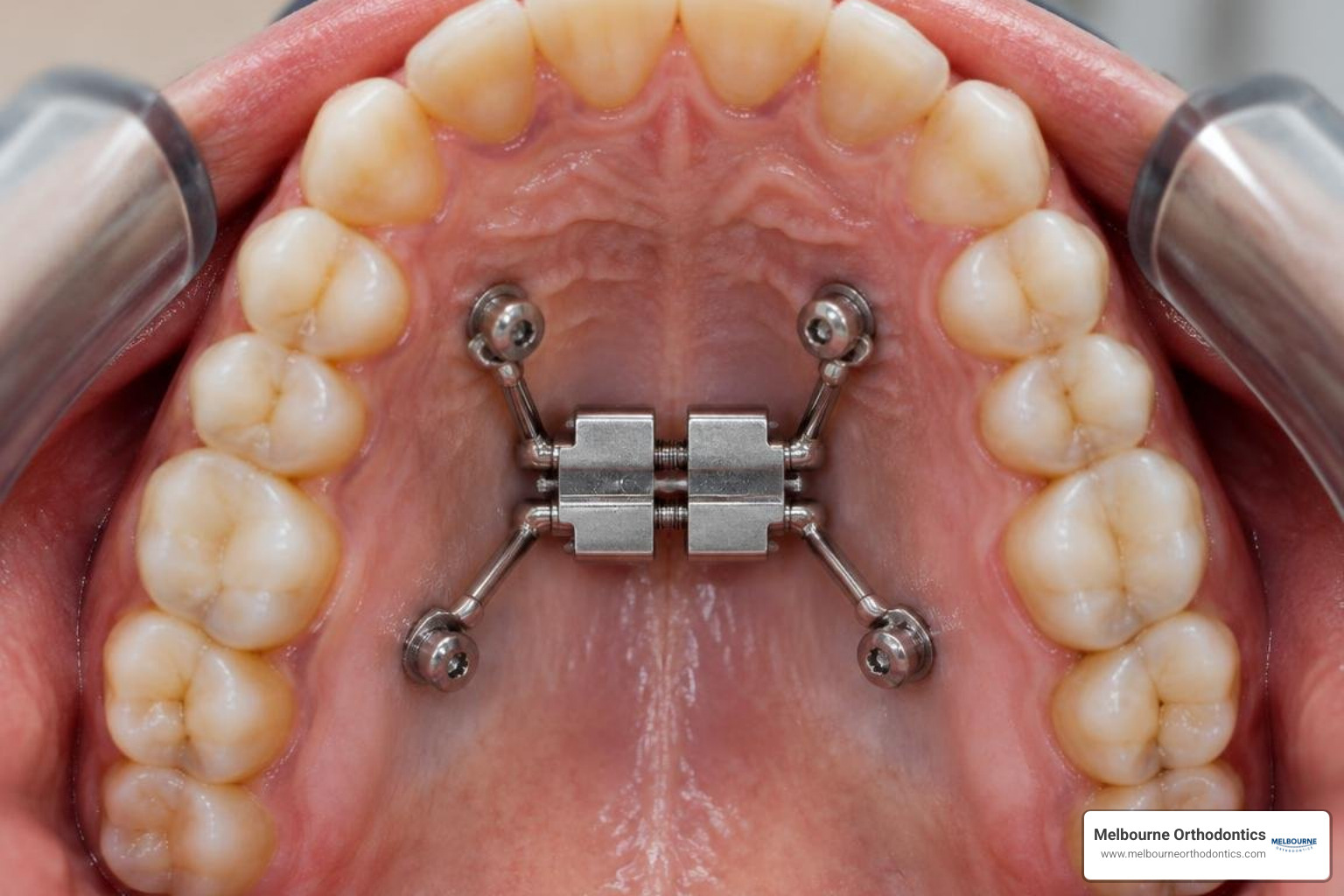
Fortunately, modern adult orthodontics offers Miniscrew-Assisted Rapid Palatal Expansion (MARPE). By placing temporary anchorage devices (TADs)—tiny biocompatible micro-implants—directly into the palatal bone, the MARPE delivers forces straight to the skeletal base rather than relying solely on the teeth. This allows us to achieve non-surgical maxillary expansion in mature patients who previously required invasive Surgically Assisted Rapid Palatal Expansion (SARPE). Explore widening your arch in adulthood with MARPE to learn more about this approach.
Daily Life and Management: Activation, Diet, and Oral Care
Adapting to an expander takes just a few days of patience. Knowing what to expect with activations, meal choices, and cleaning ensures a smooth and comfortable experience.
Activating the Jackscrew Mechanism with a Key
For fixed rapid expanders, adjustments are performed at home by a parent or guardian using a specialized activation key.
Follow these simple steps:
- Find Good Lighting: Have your child tilt their head back in a well-lit room or use a small flashlight.
- Insert the Key: Carefully slide the metal tip of the key completely into the visible hole in the center of the jackscrew.
- Turn Toward the Throat: Push the key firmly toward the back of the mouth until you complete a full rotation and a new hole appears at the front.
- Remove Carefully: Slide the key straight downward and out without reversing the turn.
Most patients feel a slight sensation of pressure across the bridge of the nose or cheeks for a few minutes after a turn, which quickly subsides. Tracking each activation on a calendar or chart ensures you maintain the exact schedule prescribed during your visits.
Dietary Adjustments and Speech Adaptation
During the initial activation period, sticking to a soft diet helps sensitive teeth rest comfortably. Smoothies, pasta, yogurt, scrambled eggs, and soups are excellent choices.
To protect the appliance from loosening or breaking, avoid:
- Hard, crunchy snacks (nuts, ice cubes, hard pretzels, popcorn)
- Sticky, chewy treats (caramels, taffy, licorice, gummy candies)
- Chewing on non-food items like pen caps or fingernails
Speaking with an expander can feel strange at first, and your mouth will temporarily produce extra saliva. Reading out loud, singing along to music, and practicing tricky words (especially those with “s,” “t,” and “r” sounds) will help your tongue adapt within a few days.
Hygiene Protocols, Emergency Care, and Retention Phase
Keeping your appliance clean prevents plaque buildup and gum inflammation:
- Brush After Every Meal: Angle your toothbrush bristles around the molar bands and central jackscrew.
- Use a Water Flosser: A pressurized water stream quickly clears food particles caught between the expander frame and the palate.
- Orthodontic Wax: If a metal band rubs the inside of your cheek, apply a pea-sized piece of wax over the band for instant relief.
Once your orthodontist confirms that the desired expansion is complete, turning stops—but the appliance stays in place. The expander must be worn passively for approximately three months. This retention phase gives the newly formed bone time to mineralize and stabilize, ensuring your wider smile remains permanent.
Frequently Asked Questions About Palatal Expansion
Is it normal to see a gap between front teeth during treatment?
Yes, it is completely normal and expected. When the midpalatal suture separates, a noticeable gap (midline diastema) often appears between the upper front teeth. This gap is visual confirmation that skeletal expansion has occurred. Over the following weeks, natural elastic fibers in the gums help pull the front teeth back toward the center, closing the space on their own before braces or aligners finish aligning them.
Can adults widen their dental arch without invasive surgery?
Yes. Thanks to miniscrew-assisted expansion (MARPE), many adults can achieve true skeletal palatal widening without full jaw surgery. Because the micro-implants anchor directly into the bone of the palate, the expander exerts force on the fused suture itself, offering an effective option for mature patients with narrow arches.
What happens if an orthodontic appliance becomes loose?
If an expander band comes loose on one side, stop turning the key immediately. Call our Melbourne or Indian Harbour Beach office so we can schedule a quick visit to clean and re-cement the band. In the meantime, stick to soft foods and avoid wiggling the appliance with your tongue or fingers.
Conclusion
Correcting a narrow palate or crossbite early can prevent impacted teeth, reduce the need for permanent tooth extractions, and create a broad, functional bite. Whether your child needs early Phase I intervention or you are an adult seeking a wider smile, our team develops customized treatment plans tailored to your specific anatomy and goals.
If your comprehensive orthodontic plan includes interarch elastics, patients are recommended to change their interarch elastics at least once a day to maintain steady, effective progress.
To discover the right treatment path for your family, schedule a consultation for orthodontic appliances with Melbourne Orthodontics today.