Palatal Expander Basics: 101
How an Expander Palatal Appliance Works to Widen the Upper Jaw
To appreciate how palatal expansion works, it helps to understand the anatomy of the upper jaw (the maxilla). The roof of the mouth is not a single solid bone during childhood. Instead, it consists of two distinct palatal halves connected down the middle by a junction of fibrous tissue known as the mid-palatal suture.
When an orthodontist fits an expander to the upper dental arch, the device delivers a calibrated orthopedic lateral force ranging from 8 to 160 N across the palate. Unlike regular braces, which focus purely on moving individual teeth through the alveolar bone, an expander applies direct orthopedic force to the underlying skeletal structure. By gently pushing outward against the posterior teeth and alveolar ridges, the appliance gradually guides the two halves of the maxilla apart.
A standard rapid palatal expander can widen the upper jaw at an average rate of 0.5 millimeters per day during active activation. As the mid-palatal suture gently opens, the body initiates a natural biological healing response called osteogenesis (new bone formation). Specialized cells fill the newly created microscopic space with fresh bone matrix, establishing structural stability. Understanding the purpose of an expander makes it clear why orthopedic expansion is such a cornerstone of modern orthodontic care: it corrects transverse skeletal discrepancies at the structural foundation rather than simply disguising them.

Correcting Crossbites, Crowding, and Impacted Teeth
When the upper jaw is too narrow relative to the lower jaw, several bite and alignment complications develop. The most frequent issue is a posterior crossbite, where the upper back teeth bite inside the lower teeth rather than resting comfortably outside them. Leaving a crossbite untreated can cause functional chewing difficulties, premature tooth wear, and asymmetric jaw growth over time.
A constricted upper arch also robs permanent teeth of the physical perimeter they need to erupt straight. By widening the jawbone, a palatal expander increases the overall circumference of the dental arch. This extra space helps resolve severe dental crowding naturally, dramatically reducing or even eliminating the need for permanent tooth extractions later in life.
Furthermore, expanding the maxilla creates necessary runway for impacted teeth—especially upper canines—to descend smoothly into their proper positions. Recognizing the early signs your child may need orthodontic treatment allows our team to address narrow arches before erupting teeth become painfully blocked or trapped beneath the gums.
Airway Benefits and Nasal Breathing Improvements
The roof of your mouth forms the floor of your nasal cavity. Consequently, a high, narrow, V-shaped palatal vault reduces total internal nasal volume and elevates nasal airflow resistance. Children with constricted upper jaws frequently struggle with chronic mouth breathing, frequent nighttime waking, loud snoring, and poor sleep quality.
When an expander widens the palate, it simultaneously drops and broadens the nasal floor. This anatomic change expands the internal nasal passages, substantially improving nasal airflow dynamics. While an expander is not an outright cure for every pediatric sleep disorder, expanding a constricted maxilla frequently serves as an integral supportive therapy for pediatric patients dealing with restricted airways and sleep-disordered breathing.
Types of Palatal Expanders and Ideal Treatment Timing
Not every mouth requires the exact same appliance design. Orthodontists utilize various expander styles depending on the patient’s age, skeletal maturity, and specific dental needs.
| Expander Type | Primary Mechanism | Best Candidate Age Group | Typical Expansion Time |
|---|---|---|---|
| Rapid Palatal Expander (RPE) | Fixed metal frame with central jackscrew | Children and early adolescents (Ages 7–14) | 2 to 3 months |
| Removable Expander (Schwarz) | Acrylic plate with midline expansion screw | Young children with mild transverse needs (Ages 5–8) | 3 to 6 months |
| 3D-Printed Sequential Expander | Series of progressive clear polymer shells | Growing children needing gradual, screwless widening | 3 to 6 months |
| MARPE (Miniscrew-Assisted RPE) | Fixed expander anchored by palatal micro-implants | Late teens and young adults with mature sutures | 3 to 6 months |
| SARPE (Surgically-Assisted RPE) | Expander combined with minimally invasive osteotomy | Adults with fully fused mid-palatal sutures | 6 to 12 months |
Knowing how these appliances function allows families to make room: what you need to know about palatal expanders as part of a well-structured orthodontic journey.
Selecting the Right Expander Palatal Appliance for Your Needs
Every smile presents unique anatomical requirements. Here are the primary appliances we consider:
- Fixed Rapid Palatal Expanders (RPE): The gold standard for growing arches. These devices feature smooth metal bands cemented securely to the upper first molars, connected to a central jackscrew. Some designs (like the Hyrax) use an all-metal hygienic framework, while others (like the Haas) incorporate acrylic pads that gently rest along the lateral palatal vault.
- Bonded Acrylic Expanders: Instead of individual metal molar bands, this appliance covers the entire chewing surface of the upper back teeth with smooth acrylic. This style is helpful in younger children or patients with open bites, as the acrylic acts as a temporary bite block during active widening.
- Removable Expanders: Devices like the Schwarz expander utilize custom acrylic and wire clasps. They work well for minor arch expansion in very cooperative young children, though compliance is critical because the device must be worn consistently to work.
- Sequential Clear Expanders: Next-generation 3D-printed polymer appliances apply continuous, calibrated lateral forces (8 to 160 N) in progressive stages, offering a screwless alternative for select pediatric cases.
- MARPE & SARPE: For older teens and adults whose skeletal bones have calcified, bone-anchored miniscrews (MARPE) or surgical assistance (SARPE) unlock the rigid suture so the jaw can widen safely.
To explore how these devices fit into comprehensive orthodontic care, take a look at our overview of orthodontic appliances beyond braces.
Early Childhood Intervention vs. Adult Expansion
Timing is everything in skeletal orthodontics. The mid-palatal suture remains flexible and responsive throughout childhood, making ages 7 and 8 the sweet spot for an initial orthodontic evaluation. In young children, achieving the desired skeletal expansion usually takes just two to three months because the developing bone moves readily under gentle pressure.
Girls generally complete their skeletal growth earlier than boys, meaning their palatal sutures begin fusing earlier in adolescence. Once a person reaches late adolescence or adulthood, the mid-palatal suture calcifies and locks into place. At that point, applying pressure solely to the teeth can cause them to tip outward rather than widening the skeletal jawbone.
Starting with early treatment takes advantage of natural growth windows, turning what could be a complex surgical case in adulthood into a straightforward pediatric correction. Through proactive interceptive orthodontics, we guide natural facial development to build a balanced, functional smile from the very start.
What to Expect: Activation, Sensations, and Daily Maintenance
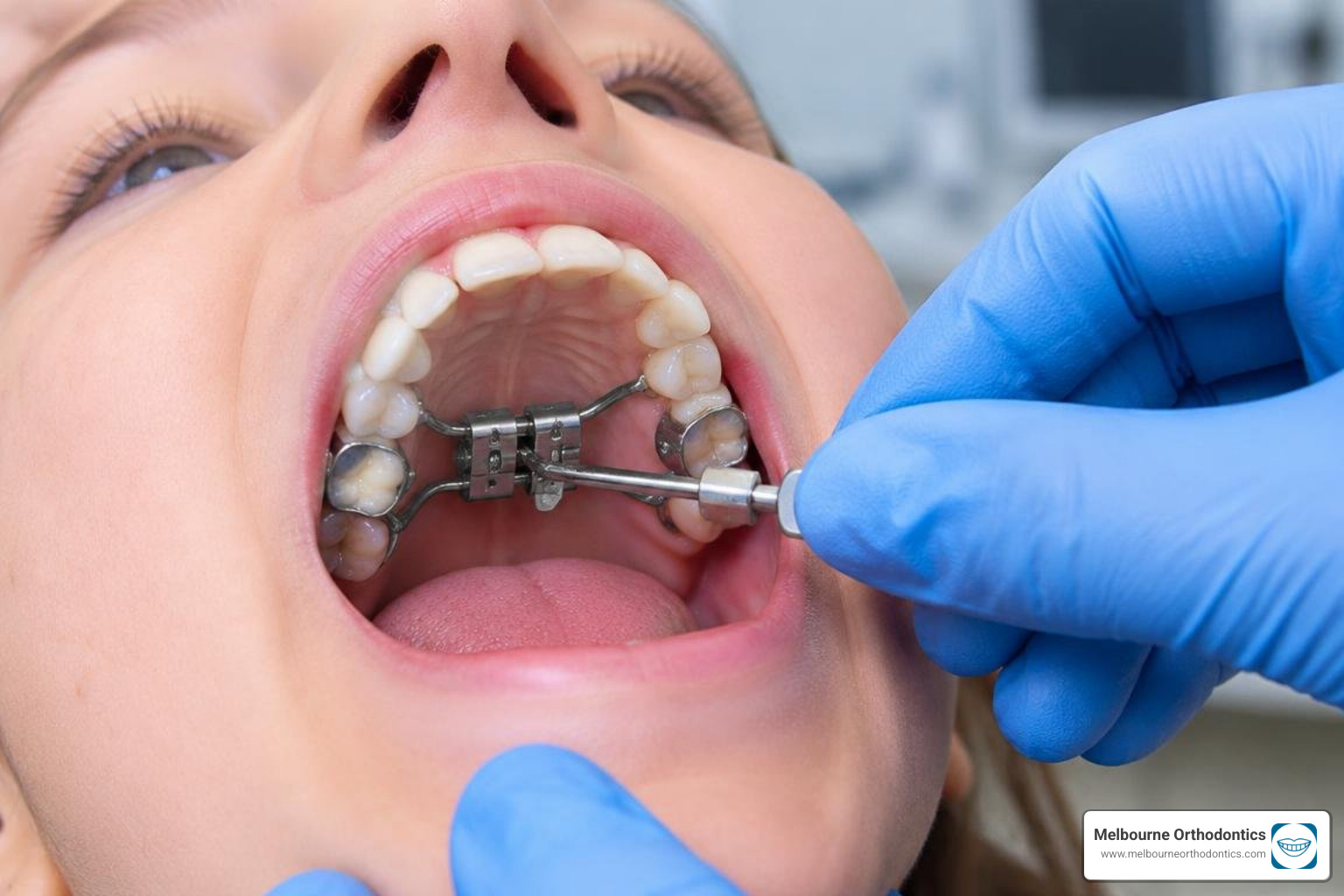
Getting an expander fitted is a completely painless procedure. Before the appliance is cemented in place, your orthodontist might place tiny rubber rings between the back teeth to create a sliver of space for the molar bands. If you want to know how those little rings function, check out our guide clearing up the confusion about spacers.
Once the expander is seated, the patient enters the activation phase. During this time, a parent or patient activates the central mechanism according to a precise schedule.
Daily Activation and Care for an Expander Palatal Device
Adjusting a fixed expander is simple once you get the hang of it. Here is the step-by-step routine:
- Find good lighting: Have the patient lie back on a comfortable couch or bed with their head tilted slightly backward under direct, bright light.
- Seat the key: Insert the metal activation key firmly into the visible front hole of the expander’s center mechanism.
- Rotate backward: Push the key gently toward the back of the mouth in the direction of the engraved arrow until the mechanism rotates completely and a fresh keyhole rotates into view at the front.
- Withdraw cleanly: Press the key downward toward the tongue and pull it out smoothly without reversing the rotation.
Patients typically feel a brief sensation of tightness or gentle pressure across the roof of the mouth and at the bridge of the nose for 2 to 5 minutes after a turn. Keeping a simple turn-tracking log on your calendar ensures you stay on schedule for every orthodontic checkup.
Proper oral hygiene is critical while wearing an expander. Because food particles can collect between the appliance and the roof of the mouth, we recommend:
- Brushing after every meal: Pay close attention to the gumline around the molar bands to prevent puffy, swollen gums from growing over the metal edges.
- Using a water flosser: A targeted stream of water effortlessly rinses away trapped food debris underneath the center screw and bars.
- Eating softer foods initially: Stick to smooth foods like yogurt, pasta, smoothies, and mashed potatoes for the first few days.
- Avoiding sticky or crunchy snacks: Steer clear of caramel, taffy, chewing gum, whole nuts, and ice cubes, which can bend or dislodge the appliance.
The 4 to 6 Month Bone Stabilization Phase
Once the orthodontist confirms that the upper jaw has reached its ideal width, active key-turning stops. However, the appliance is not removed immediately.
Even after the palate expands to the appropriate width, the device is typically left in place for an additional four to six months. This passive retention period allows the newly formed bone tissue in the mid-palatal suture to calcify, harden, and permanently stabilize. Removing an expander too early can lead to skeletal relapse, causing the jaw to narrow again.
After the bone has fully ossified, we remove the expander and smoothly transition the patient into comprehensive braces or clear aligners to align individual teeth perfectly. During this next phase of bite refinement, we recommend that patients change their interarch elastics at least once a day to maintain optimal, continuous tooth movement. Having the right tools makes all the difference, as we highlight in our guide to appliances for every dental occasion.
Frequently Asked Questions About Palatal Expansion
Does turning a palatal expander hurt?
Palatal expansion does not cause severe pain. Most patients experience a sensation of fullness, tightness, or mild pressure across the cheekbones, upper teeth, and between the eyes for several minutes following an activation turn. Any mild initial soreness or tongue irritation during the first few days can be easily managed with over-the-counter pain relievers like ibuprofen or acetaminophen. Children adapt remarkably quickly, and speech returns to normal within just a few days of reading out loud.
Why is a gap opening between my child’s front teeth?
Seeing a space open between your child’s two upper front teeth (called a midline diastema) can look surprising, but it is actually the best proof that the expander is doing its job! The gap confirms that the two halves of the upper jawbone are separating orthopedically rather than just tilting the teeth outward.
Once active turns stop, the elastic fibers in the gum tissue naturally pull the front teeth back toward the center over several weeks, partially closing the gap on their own. Any remaining spacing is effortlessly closed during the braces phase of care.
Can adults widen their palate without surgery?
Because the mid-palatal suture calcifies and fuses solidly by late adolescence, standard tooth-borne expanders cannot reliably separate adult palatal bones on their own. When adults need upper jaw expansion, we use advanced techniques like Micro-implant Assisted Rapid Palatal Expansion (MARPE), which anchors directly into the palatal bone with temporary miniscrews, or Surgically Assisted Rapid Palatal Expansion (SARPE). These modern methods allow adults to enjoy the functional, cosmetic, and airway benefits of a broader upper arch safely and predictably.
Conclusion
A palatal expander is one of the most reliable and transformative tools in modern orthodontics. By broadening a constricted upper jaw during active growth, expansion corrects crossbites, relieves severe crowding, protects emerging permanent teeth, and enhances nasal airway function.
At Melbourne Orthodontics, we provide warm, family-focused orthodontic care tailored to each patient’s unique facial structure. Whether you are seeking early interceptive treatment for your child or exploring adult arch expansion, our experienced team will design a personalized plan that sets your smile up for lifelong health.
We welcome patients to our comfortable practice locations in Melbourne, Florida, and Indian Harbour Beach, Florida. Contact us today to schedule your comprehensive orthodontic consultation and learn more about our advanced treatment options and appliances.