What Happens to Your Jaw Before and After a Palatal Expander
How a Palatal Expander Works on Jaw Anatomy
Before and after a palatal expander, the upper jaw widens to correct a narrow palate, crossbites, and dental crowding. The expander gradually separates the two halves of the upper jaw at the midpalatal suture, creating space for teeth and improving bite alignment.
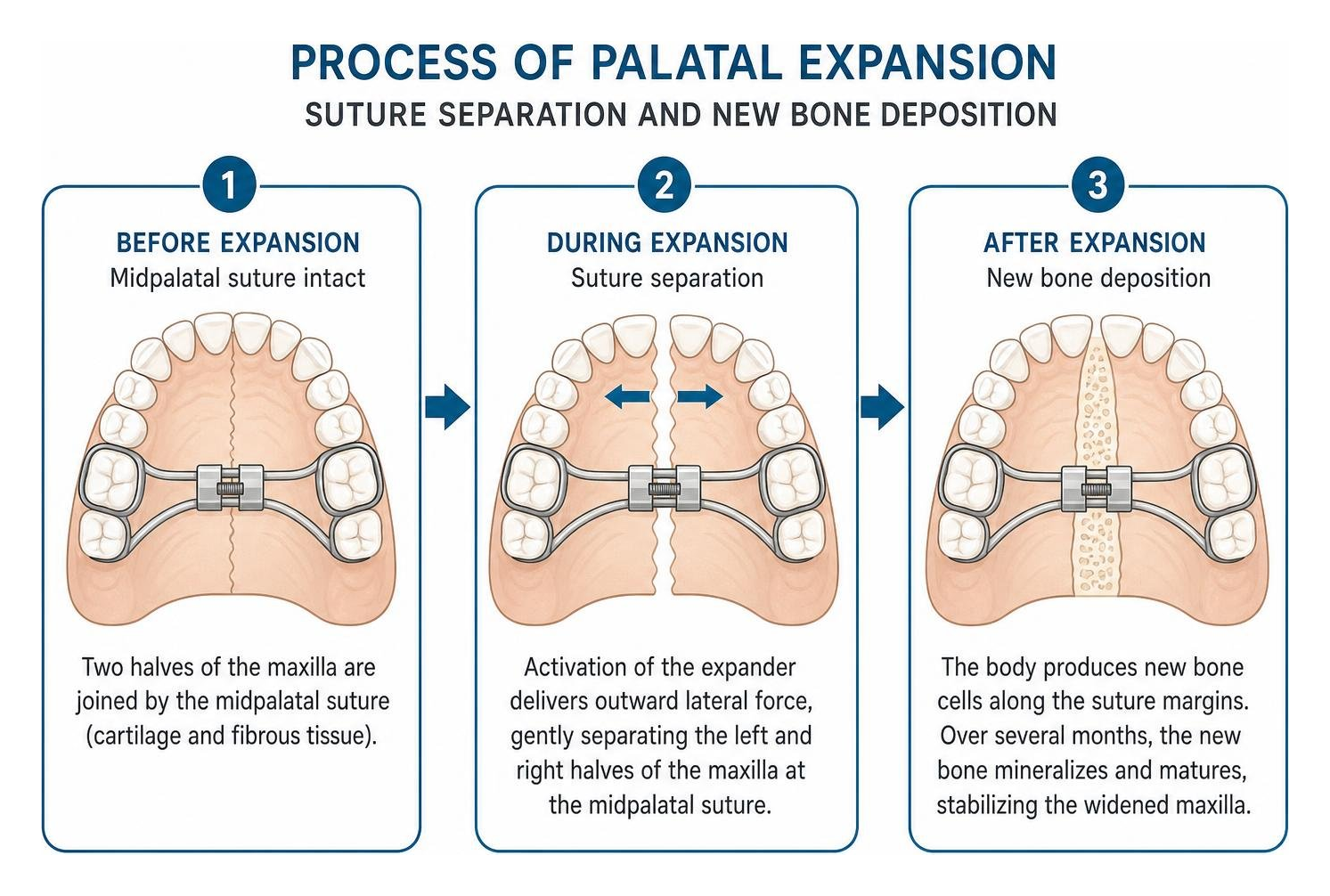
To understand what occurs during treatment, it helps to look at the anatomy of the upper jaw (maxilla). The roof of the mouth is not a single solid bone in childhood and adolescence. Instead, it consists of two distinct halves connected down the middle by cartilage and fibrous tissue known as the midpalatal suture.
A rapid palatal expander (such as a Hyrax appliance) is custom-fitted to the upper arch, usually anchoring securely around the upper first molars. At the center of the appliance sits a miniature jackscrew mechanism. When activated using a specialized key, the jackscrew delivers outward lateral force directly against the upper dental arch and the underlying palatal shelves.
This outward pressure stimulates two complementary biological events:
- Suture separation: The mechanical tension gently separates the left and right halves of the maxilla at the midpalatal suture.
- Bone remodeling (osteogenesis): As the two halves move apart, the body responds to the space by producing new bone cells along the suture margins. Over several months, this newly formed bone mineralizes and matures, stabilizing the widened upper jaw in its new position.
By widening the underlying skeletal framework, we increase the overall perimeter of the dental arch, giving permanent teeth room to erupt naturally while balancing the width of the upper jaw with the lower jaw.
Skeletal vs. Dental Expansion Dynamics
An important distinction in orthodontic treatment is the difference between skeletal expansion and dental expansion.
- Skeletal Expansion: Occurs when the midpalatal suture itself opens, moving the underlying maxillary bones apart. This adds true basal bone width, expands the floor of the nasal cavity, and provides a broader structural foundation.
- Dental Expansion: Involves the outward tipping (buccal tipping) or bodily movement of individual teeth within the existing jawbone. While it can resolve mild alignment concerns, tipping alone does not change the transverse dimension of the maxilla.
In younger patients whose sutures are still open and adaptable, rapid expansion produces predominantly skeletal movement with minimal dental tipping. In skeletally mature individuals, the fused suture resists separation, meaning tooth-borne appliances alone will primarily cause teeth to tip outward against the cortical bone rather than widen the jaw itself.
Palatal Expander Before and After: Key Visual and Structural Changes
When comparing patient records before and after palatal expansion, several distinct visual, functional, and structural milestones emerge:
| Feature | Before Palatal Expansion | After Palatal Expansion & Consolidation |
|---|---|---|
| Upper Arch Shape | Narrow, V-shaped, or constricted arch | Broad, U-shaped, well-rounded arch |
| Bite Relationship | Posterior crossbite (upper back teeth bite inside lower teeth) | Normal transverse overlap (upper molars properly overlap lower molars) |
| Front Teeth Alignment | Severe crowding, overlapping, or blocked incisors/canines | Spacing gained; temporary midline diastema opens and resolves |
| Buccal Corridors | Dark shadows visible at the corners of the mouth when smiling | Broader smile display with reduced negative space at the mouth corners |
| Nasal Airway Volume | Constricted nasal floor; higher incidence of mouth-breathing | Expanded nasal base width, facilitating clearer nasal airflow |
| Facial Symmetry | Potential functional chin shift caused by an uneven, narrow bite | Centered jaw trajectory and improved lower-facial balance |
Beyond the dental changes, widening a constricted palate directly expands the base of the nasal cavity. Many patients who previously struggled with chronic mouth-breathing report improved nasal airflow once the skeletal expansion phase is complete.
What to Expect: Palatal Expander Before and After in Children and Teens
In children and young adolescents (typically between ages 7 and 14), the midpalatal suture is open and highly responsive to orthopedic force. Orthodontists evaluate skeletal maturity using diagnostic imaging, often referencing the Angelieri suture maturation stages (Stages A through C indicate an open or lightly interdigitated suture).
During this developmental window:
- Phase 1 Interceptive Orthodontics: Expanding the jaw early can eliminate crossbites that force the lower jaw to shift awkwardly to one side, preventing asymmetric facial growth.
- Space Creation: Expansion adds significant arch perimeter, dramatically reducing the risk of permanent teeth becoming impacted (such as blocked canine teeth) and often eliminating the future need for tooth extractions.
- The Midline Gap: Within 10 to 14 days of activation, parents and teens will notice a noticeable space (diastema) appearing between the two upper central incisors. While surprising at first glance, this gap is the clearest visual indicator that the skeletal suture has cleanly separated.
Palatal Expander Before and After in Adults: Non-Surgical vs. SARPE
Once a patient completes skeletal growth (typically in late adolescence or early adulthood), the midpalatal suture ossifies and fuses securely. Because heavy mechanical forces on fully fused bone can lead to periodontal recession, tooth tipping, or bone loss, adults require specialized treatment approaches:
- MARPE (Micro-Implant Assisted Rapid Palatal Expansion): Utilizes temporary mini-implants (TADs) anchored directly into the palatal bone. This allows direct transfer of force to the skeleton, enabling non-surgical skeletal expansion in select young adults.
- SARPE (Surgically Assisted Rapid Palatal Expansion): For mature adults with severe transverse maxillary deficiency, an oral surgeon performs minimally invasive cuts (osteotomies) along the lateral maxillary walls and midpalatal suture under outpatient care. This releases the structural resistance, allowing a custom expander to gently widen the bone over the following weeks.
In both adult modalities, the post-treatment outcome delivers a stable, wide maxillary arch, normal chewing mechanics, and enhanced facial aesthetics without compromising periodontal health.
The Treatment Timeline: From Initial Placement to Retention
The overall journey with a palatal expander follows a structured, step-by-step clinical protocol:

- Step 1: Placement & Instructions (Day 1): The appliance is bonded to the upper molars. The orthodontist provides an activation schedule and demonstrates how to turn the jackscrew key.
- Step 2: Active Expansion (Weeks 1 to 3): The appliance is turned according to the prescribed routine (often 1–2 turns per day). The midline gap opens, and the upper jaw reaches its target transverse width.
- Step 3: Passive Consolidation (Months 1 to 6): Turning stops, but the expander remains fixed in the mouth for approximately 3 to 6 months. This critical stabilization window gives the newly created bone tissue time to fully mineralize and mature.
- Step 4: Appliance Removal & Secondary Alignment: The expander is removed, and comprehensive alignment begins with traditional braces or clear aligners to close remaining spaces and detail the final occlusion.
Daily Expander Maintenance and Hygiene
Keeping the appliance clean ensures healthy gum tissue and steady progress throughout treatment:
- Rinse after eating: Swish vigorously with water after every meal to dislodge trapped food particles around the center screw.
- Targeted brushing: Use a soft-bristle toothbrush or an orthodontic interdental proxy brush to clean around the bands, acrylic pads, and metal arms.
- Oral irrigators: A water flosser on a gentle setting can clear debris beneath the palate bars without disturbing the appliance.
- Avoid sticky or hard foods: Steer clear of caramel, chewing gum, hard candies, popcorn, and ice cubes, which can bend wires or loosen the bonded bands.
Managing Discomfort, Speech Changes, and Elastic Wear
Adapting to an expander takes just a few days. Patients may notice:
- Pressure Sensations: A brief feeling of pressure across the bridge of the nose, cheekbones, or palate immediately after turning the key. This is normal and fades within minutes.
- Speech Adjustments: A temporary lisp is common during the first 48 to 72 hours as the tongue learns to navigate around the center appliance. Reading aloud or singing helps speech return to normal quickly.
- Excess Salivation: The brain initially mistakes the new appliance for food, causing extra saliva production for a day or two.
- Consistent Elastic Wear: If your treatment plan includes interarch elastics to guide bite correction, patients are recommended to change their interarch elastics at least once a day to ensure consistent, gentle elasticity throughout the day.
Long-Term Stability and Space Creation for Subsequent Orthodontics

Widening the palate is often the foundational first phase of comprehensive orthodontic care. By correcting the structural width of the upper jaw early, subsequent alignment becomes simpler, faster, and more stable.
- Non-Extraction Alignment: Expanding the arch creates the millimeter-by-millimeter perimeter required to bring crowded, rotated, or high-riding canines down into clean alignment without needing permanent tooth extractions.
- Bite Stability: A properly proportioned upper arch fits securely over the lower arch like a lid on a box. This eliminates abnormal wear patterns on enamel and protects the temporomandibular joints (TMJ) from strain.
- Relapse Prevention: Following phase-two braces or aligners, long-term retention (such as custom clear retainers or bonded wires) maintains both the transverse arch width and individual tooth positions for a lifetime of healthy function.
Frequently Asked Questions About Palatal Expanders
How long does it take to see visible results after starting an expander?
Visible changes occur rapidly during the active expansion phase. Most patients notice the upper arch widening and a distinct gap opening between the two upper front teeth within 7 to 14 days of starting daily activations. However, the expander must remain in place for 3 to 6 months after turning stops to allow the new bone inside the suture to fully mineralize.
Does turning a palatal expander cause severe pain?
No. Patients typically feel mild pressure across the roof of the mouth, cheekbones, or bridge of the nose for 5 to 15 minutes after a turn, rather than sharp pain. Over-the-counter pain relievers taken during the first few days easily manage any temporary soreness as the mouth adapts.
Will the gap between the front teeth close on its own after expansion?
Yes. The temporary gap (midline diastema) that forms between the two front central incisors naturally begins closing within a few weeks after active turning concludes. Elastic gum fibers (transeptal fibers) pull the teeth back toward the center. Any remaining spacing is then neatly closed during the subsequent phase of braces or clear aligners.
Conclusion
A narrow upper jaw can lead to a host of functional and aesthetic concerns, from crossbites and severe dental crowding to mouth-breathing and facial asymmetry. Evaluating a patient’s bite with a focus on transverse jaw dimensions helps ensure that orthodontic care builds a stable, healthy foundation from the start.
Whether guide-growing the palate of an energetic adolescent or coordinating specialized expansion for adults, our team at Melbourne Orthodontics provides caring, personalized care in Melbourne and Indian Harbour Beach. If you or your child are ready to explore custom orthodontic appliances and expansion options to transform your smile, contact our office today to schedule an initial consultation.