Fast Track to a Broader Smile with Rapid Palatal Expanders
What Is a Rapid Palatal Expander and How Does It Work?
A rapid palatal expander delivers controlled lateral force to the upper jaw (maxilla). The human maxilla is not a single solid bone during childhood; it consists of two distinct halves joined down the middle by the mid-palatal suture. By applying steady, outward pressure against the posterior teeth and palatal shelves, the appliance gently separates this suture.
This process—known orthopedically as mid-palatal suture distraction—stimulates the body’s natural healing response. As the two halves separate, tension across the suture triggers osteoblasts (bone-forming cells) to generate new bone matrix within the gap. True orthopedic expansion results in skeletal widening rather than merely tipping the molars outward, preserving periodontal support and root health.
Understanding the purpose of an expander involves looking at the appliance’s engineering. At the core of the expander sits a precision jackscrew welded to a rigid stainless steel or 3D-printed metal framework. Turning this screw produces outward force that transfers through the anchorage points to the underlying skeletal structures. Each quarter turn typically activates the screw by about 0.25 mm.
Because the roof of the mouth also forms the floor of the nasal cavity, skeletal expansion widens the nasal vault. Research shows that widening a constricted maxilla reduces nasal airway resistance and improves nasal airflow volume. This structural change often helps patients shift away from chronic mouth breathing toward healthier nasal breathing patterns.

Conditions Treated by Palatal Expansion
Orthodontists use rapid maxillary expansion to resolve several common dental and skeletal issues:
- Posterior Crossbite: When the upper jaw is too narrow, the upper back teeth bite inside the lower back teeth rather than slightly outside them. This misalignment causes functional jaw shifting, asymmetrical facial growth, and uneven dental wear.
- Severe Dental Crowding: A constricted dental arch lacks the perimeter necessary for permanent teeth to erupt cleanly. Widening the palate creates needed space along the arch perimeter, often preventing the need to extract permanent premolars later.
- Impacted Canines: Maxillary canines travel a long eruption path. A narrow arch can deflect these teeth, causing them to become impacted in the palate or damaging neighboring roots. Expanding the arch opens the path for natural canine eruption.
- Narrow Arch and Airway Constriction: Constricted palates leave less tongue space, which can push the tongue backward toward the airway. Expanding the arch provides room for proper tongue posture against the palate.
Knowing the types of malocclusion helps parents identify bite discrepancies early. Recognizing common signs you may need orthodontic treatment—such as speech impediments, asymmetrical chewing, or mouth breathing—ensures timely intervention.
Optimal Timing and Age for Rapid Palatal Expander Treatment
Timing is a critical factor in orthopedic expansion. In infants and young children, the mid-palatal suture is a relatively smooth, pliable connective tissue joint. As a child approaches puberty, this suture undergoes interdigitation—developing interlocking, jagged bony projections that gradually fuse (synostosis).
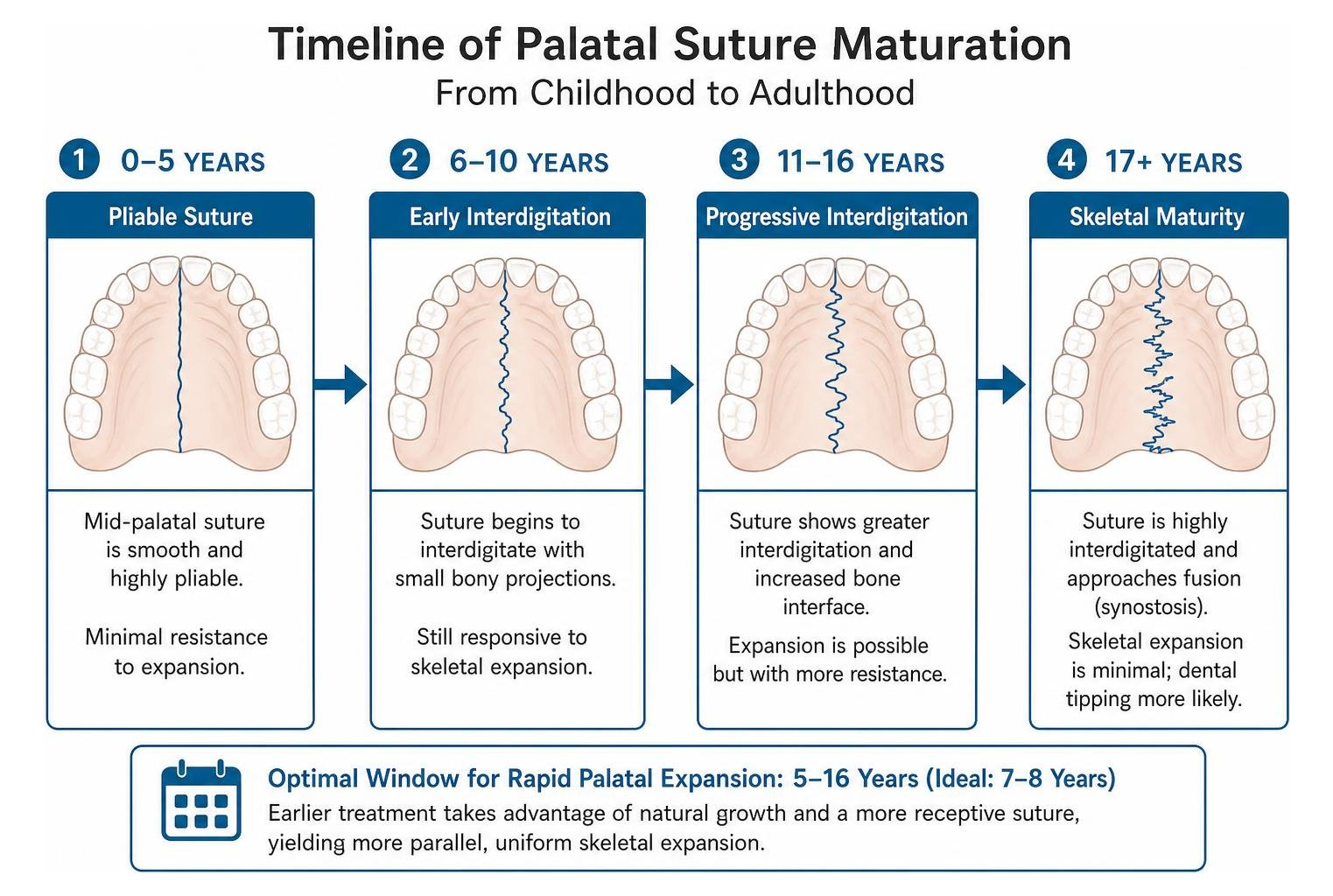
The optimal window for treatment occurs between ages 5 and 16, with ages 7 to 8 often providing ideal anatomical conditions. During early mixed dentition, the suture offers minimal resistance to distraction, yielding parallel, uniform skeletal expansion. In older adolescents, the fused suture resists expansion, resulting in more V-shaped expansion patterns and a higher proportion of dental tipping relative to skeletal movement.
The American Association of Orthodontists recommends that every child receive a comprehensive orthodontic evaluation by age 7. Initiating early treatment takes advantage of natural growth spurts. Evaluating a child during this window answers the question, “when should my child get braces?” and allows for effective interceptive orthodontics that simplifies future care.
Comparing Different Types of Palatal Expanders
Orthodontists select from several expander designs based on skeletal age, dental development, and individual treatment goals.
| Expander Type | Anchorage Method | Primary Indication | Key Advantages |
|---|---|---|---|
| Hyrax (Tooth-Borne) | Bands cemented to molars and premolars | General transverse deficiency in growing kids | Hygienic all-metal frame; easy to clean |
| Haas (Tooth-Tissue-Borne) | Bands on molars + acrylic palatal pads | Severe maxillary constriction | Distributes forces across both teeth and palatal vault |
| Bonded Expander | Acrylic occlusal bite blocks bonded to teeth | Patients with open bites or vertical growth tendencies | Covers biting surfaces; helps control vertical eruption |
| Fan-Type Expander | Bands on molars with anterior pivot hinge | Anterior arch constriction, cleft palate | Expands anterior arch while keeping molar width steady |
| MARPE (Bone-Borne / Hybrid) | Skeletal mini-implants (TADs) ± molar bands | Late adolescents and adults with fused sutures | Directly engages bone; minimizes dental tipping |
Modern appliances rely on digital impressions and 3D selective laser sintering (SLS) to build fully customized metal frameworks. These digital workflows ensure exact anatomical adaptation, enhancing patient comfort. Exploring the variety of orthodontic appliances beyond braces helps demystify how these devices achieve complex dental movements.
Bonded vs. Banded Expanders and Vertical Facial Growth
A traditional banded expander (such as a Hyrax) can cause slight buccal tipping of the anchor molars. This tipping lowers the palatal cusps, which may prop open the bite and rotate the mandible downward and backward. For patients with a hyperdivergent skeletal pattern (a long, narrow face with an anterior open bite), this mandibular rotation can accentuate vertical facial height.
Bonded rapid palatal expanders address this challenge by incorporating smooth acrylic bite blocks over the occlusal surfaces of the posterior teeth. These bite blocks act as a posterior bite plane, intruding the back teeth or preventing them from erupting during active expansion.
A systematic review and meta-analysis evaluating the effects of bonded expanders on vertical facial dimensions found modest changes within six months of treatment:
- Total Facial Height (TFH): Mean increase of 0.83 mm
- Upper Facial Height (UFH): Mean increase of 0.57 mm
- Lower Facial Height (LFH): Mean increase of 0.70 mm
- Mandibular Plane Angle (SN-MP): Mean increase of only 0.71°
Compared to traditional banded expanders—which can increase the SN-MP angle by approximately 1.7°—bonded expanders provide better vertical control, helping maintain facial harmony in high-angle cases.
Adult Palatal Expansion and MARPE
Once skeletal maturity is complete in late adolescence or adulthood, the mid-palatal and circumaxillary sutures fuse. Applying standard rapid expansion forces to an adult dental arch risks severe dental tipping, gingival recession, alveolar bone dehiscence, and root resorption.
Historically, adult maxillary constriction required Surgically Assisted Rapid Palatal Expansion (SARPE), an invasive procedure involving maxillary osteotomies performed under general anesthesia. Today, Mini-Implant Assisted Rapid Palatal Expansion (MARPE) offers a non-surgical alternative.
MARPE uses four to six temporary skeletal anchorage devices (micro-implants) inserted directly through the palatal mucosa into the cortical bone. By transferring expansion forces straight to the bony palatal shelves rather than the teeth, MARPE can split fused adult sutures with high orthopedic efficiency and minimal dental side effects.
Treatment Timeline, Activation Protocols, and Side Effects
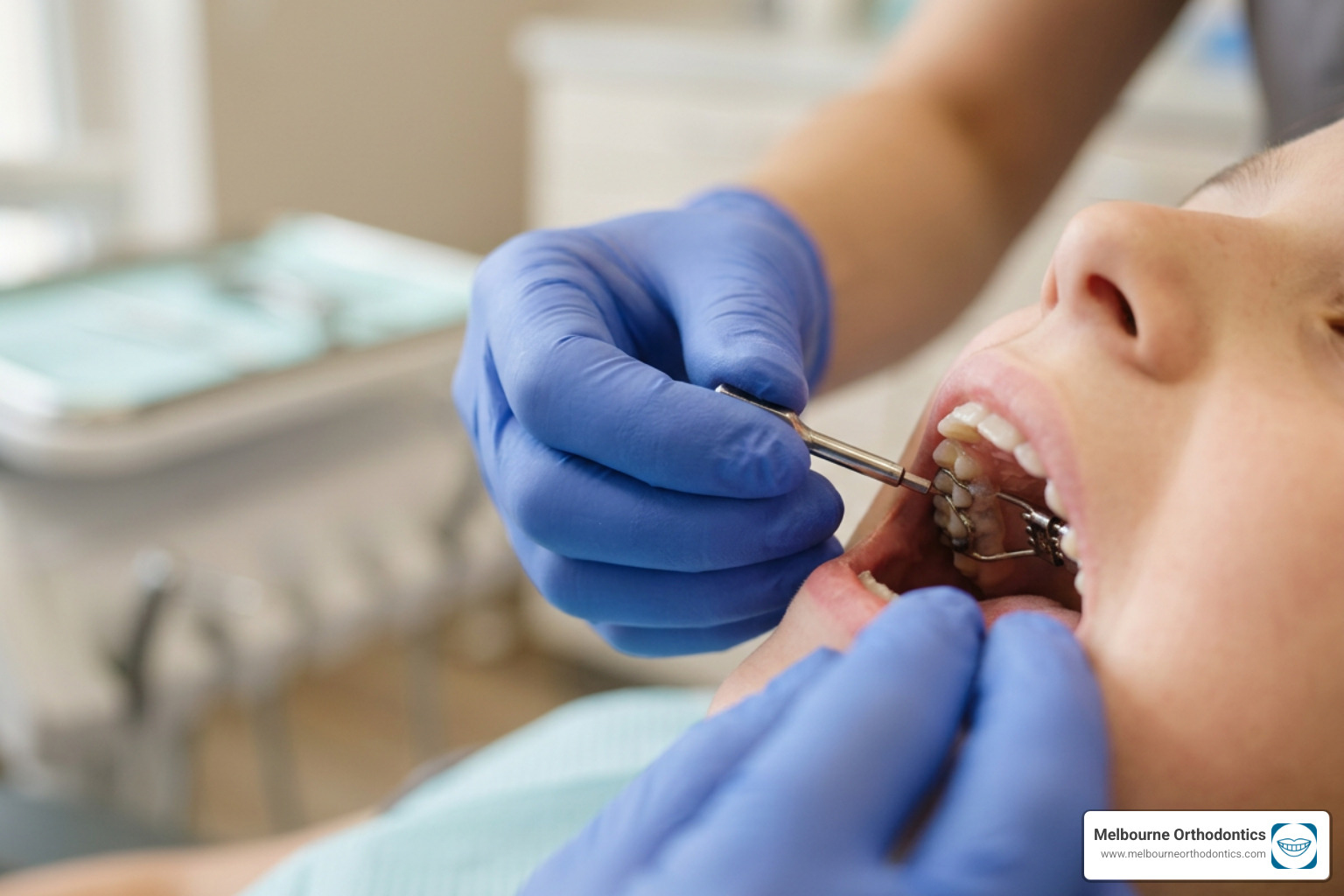
A successful expansion protocol follows a structured schedule:
- Initial Placement and Adaptation (Days 1-3): The appliance is bonded or cemented in place. The patient adjusts to eating, speaking, swallowing, and cleaning around it.
- Active Expansion Phase (Weeks 1-4+): The patient or parent activates the center jackscrew using the provided swivel key. A common protocol is one quarter turn, or about 0.25 mm, per day, though some cases require a different schedule. Active expansion usually continues until the planned upper jaw width is reached.
- Diastema Formation (Weeks 1-3): A noticeable space may appear between the two upper central incisors. This gap is a normal sign that the mid-palatal suture is opening.
- Consolidation and Retention Phase (About 6 Months): Once the target transverse width is achieved, active turning stops. The jackscrew is locked or stabilized. The appliance remains in the mouth passively for about six months while new bone fills and strengthens the expanded suture.
- Appliance Removal and Phase II Orthodontics: The expander is removed, and braces or clear aligners may be used to align the teeth and refine the bite.
Understanding how palatal expanders create room highlights why the retention window is essential for long-term stability and preventing skeletal relapse.
Potential Complications and Monitoring During Active Expansion
Rapid palatal expansion is a well-established procedure, but it requires careful clinical monitoring. Because the maxilla articulates with ten other craniofacial bones, expansion forces disperse across multiple sutures (including the zygomaticomaxillary, nasomaxillary, and frontomaxillary sutures).
Potential complications to monitor include:
- Asymmetric Expansion: Variations in skeletal resistance across the face can cause one side of the palate to expand more than the other. Studies show asymmetric expansion occurs in approximately 30.3% of micro-implant assisted cases.
- Facial Skeletal Changes: Rare case reports note unexpected responses to heavy circumaxillary strain, including temporary saddle nose deformities, suborbital hematomas, or localized unilateral facial tenderness.
- Dental Complications: Excessive expansion rates can cause buccal cortical bone fenestration, localized gingival inflammation, or root resorption if the forces overpower skeletal resistance.
Regular follow-up appointments allow your orthodontist to evaluate suture opening, verify facial symmetry, and adjust activation schedules as needed.
Daily Living and Caring for a Rapid Palatal Expander
Maintaining good daily habits keeps treatment on track and comfortable:
- Foods to Avoid: Hard foods (nuts, hard candies, ice), sticky items (caramel, taffy, chewing gum), and chewy foods (bagels, tough crusts) can bend appliance wires or dislodge bands.
- Recommended Diet: Soft, nutrient-dense foods—such as smoothies, pasta, yogurt, scrambled eggs, and soups—are ideal during the initial activation days.
- Oral Hygiene: Food debris easily collects around the jackscrew and palate. Patients should brush thoroughly for two to three minutes after every meal, using a soft-bristled toothbrush angled toward the appliance framework.
- Water Flossers and Rinses: A water flosser or oral irrigation syringe helps flush trapped food particles from behind the palatal screw. Antimicrobial mouth rinses reduce mucosal irritation.
- Interarch Elastics: If your treatment plan includes rubber bands, change interarch elastics at least once a day to ensure consistent force levels.
- Speech Practice: Reading aloud for 10 to 15 minutes a day during the first week helps the tongue adjust to the appliance, resolving temporary lisping quickly.
Understanding why investing in interceptive orthodontics matters makes these short-term adjustments well worth the effort.
Frequently Asked Questions About Palatal Expanders
Does turning a palatal expander cause pain?
Most patients describe a sensation of mild pressure or tightness across the palate, cheeks, or bridge of the nose rather than sharp pain. This feeling typically fades within 5 to 15 minutes after a turn. Over-the-counter pain relievers can help ease initial soreness during the first few days of activation.
Why does a gap develop between the front teeth during expansion?
A midline gap (diastema) between the upper two front teeth is an expected and positive sign that the skeletal suture has opened. Once turning stops, elastic fibers in the gum tissue (transseptal fibers) naturally draw the front teeth back toward the center within a few weeks. The remaining space is then distributed along the dental arch to relieve crowding.
How long does rapid palatal expansion treatment take?
Active turning usually takes 2 to 4 weeks, depending on the amount of skeletal widening needed. The expander then stays in place passively for about 6 months to allow new bone to mineralize across the suture. Total treatment time with the appliance is typically around 6 to 9 months.
Conclusion
A rapid palatal expander provides a reliable, clinically proven way to correct transverse skeletal narrowness, relieve severe crowding, eliminate posterior crossbites, and support healthier airway function. Taking advantage of natural growth during early childhood allows orthodontists to reshape the upper dental arch with lasting structural stability.
At Melbourne Orthodontics, we provide specialized pediatric, adolescent, and adult orthodontic care for families throughout Melbourne, Florida and Indian Harbour Beach, Florida. If you notice signs of crowding or bite misalignment, explore our custom orthodontic appliances and expander treatments to schedule a consultation with our team today.