Widening Your Arch in Adulthood with Miniscrew Assisted Rapid Palatal Expansion
Can Adults Widen Their Upper Jaw Without Surgery?
Yes, some adults can widen a narrow upper jaw without surgery. Miniscrew-assisted rapid palatal expansion (MARPE) uses small screws in the palate to support an expander. This directs more force to the jawbone than a traditional expander that relies on teeth alone. It is not right for everyone: an orthodontist needs to assess your bite, palate, and bone before recommending it.
I’m Dr. Chad Reddick, an orthodontist at Melbourne Orthodontics with three years of specialized orthodontic training after dental school. In this guide, I’ll explain how miniscrew assisted rapid palatal expansion works, who may benefit, and what to discuss at a consultation.
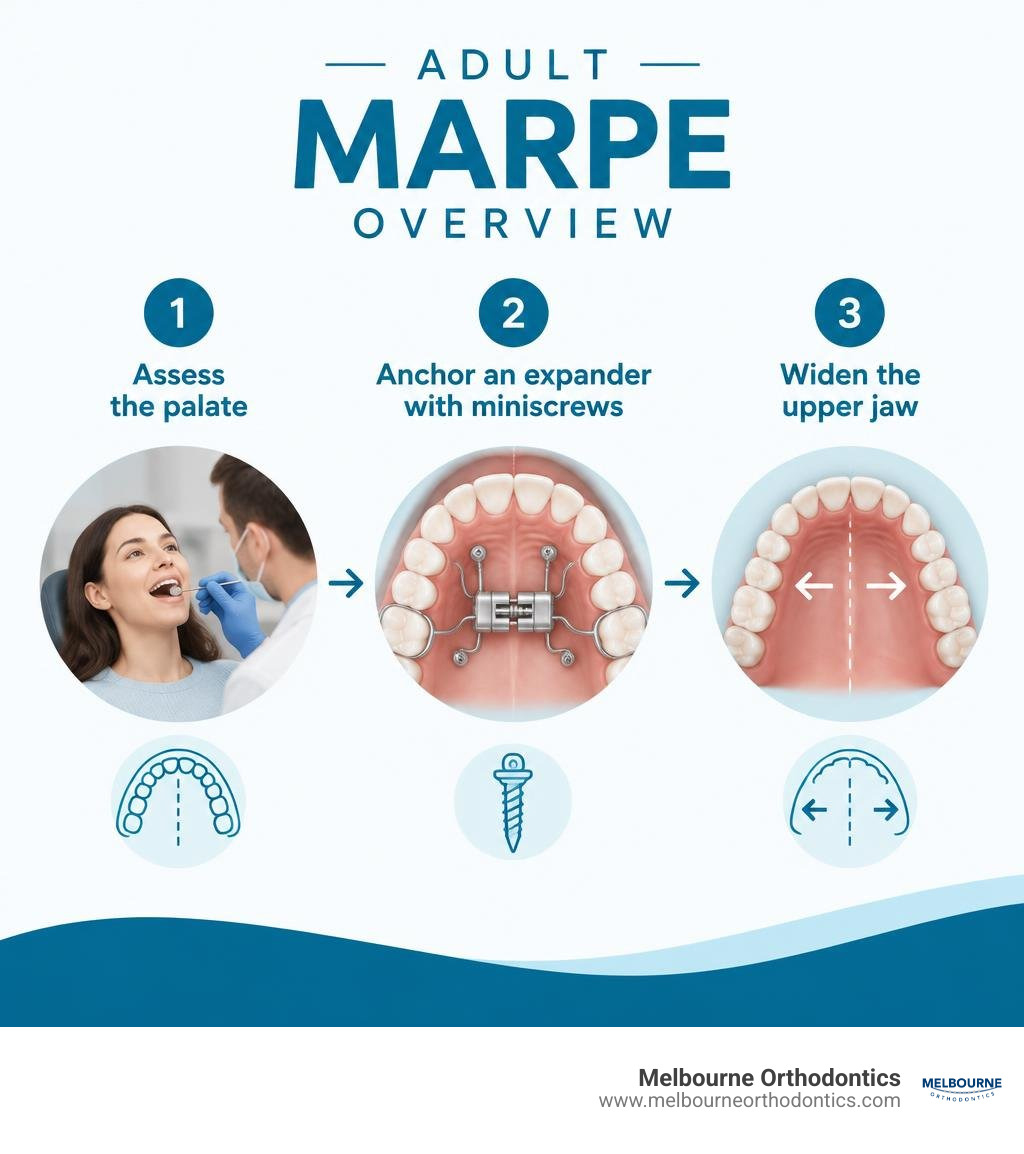
Simple miniscrew assisted rapid palatal expansion glossary:
Understanding Miniscrew Assisted Rapid Palatal Expansion
Transverse maxillary deficiency (a constricted or narrow upper jaw) is a common structural issue affecting anywhere from 8% to 23% of individuals during early dental development, and it often persists directly into adulthood. When left unaddressed, a narrow maxilla leads to dental crowding, posterior crossbites, narrow smile aesthetics, and compromised nasal airflow.
For growing children, widening the roof of the mouth is straightforward. The midpalatal suture—the biological seam connecting the left and right halves of your upper jaw—is still open and adaptable. Applying gentle lateral pressure through conventional expansion appliances easily separates this seam to encourage new bone growth.
However, as we mature, skeletal resistance increases dramatically. By late adolescence and early adulthood, the midpalatal suture fuses and interdigitates, locking the two halves of the upper jaw firmly together. For many years, clinicians believed that once this suture fused, true skeletal expansion was impossible without invasive surgical intervention.
This is where bone-borne anchorage revolutionizes modern care. Understanding the purpose of an expander in adult orthodontics requires shifting focus from moving teeth to remodeling underlying bone. MARPE overcomes mature skeletal resistance by delivering lateral forces straight into the palatal bone rather than putting destructive loads on the teeth.
How Miniscrew Assisted Rapid Palatal Expansion Works in Adults
MARPE relies on temporary skeletal anchorage devices (TADs)—tiny, biocompatible titanium miniscrews safely placed into the palate. These miniscrews achieve bicortical engagement, securing anchors into the dense cortical bone of both the oral palate and the floor of the nasal cavity.
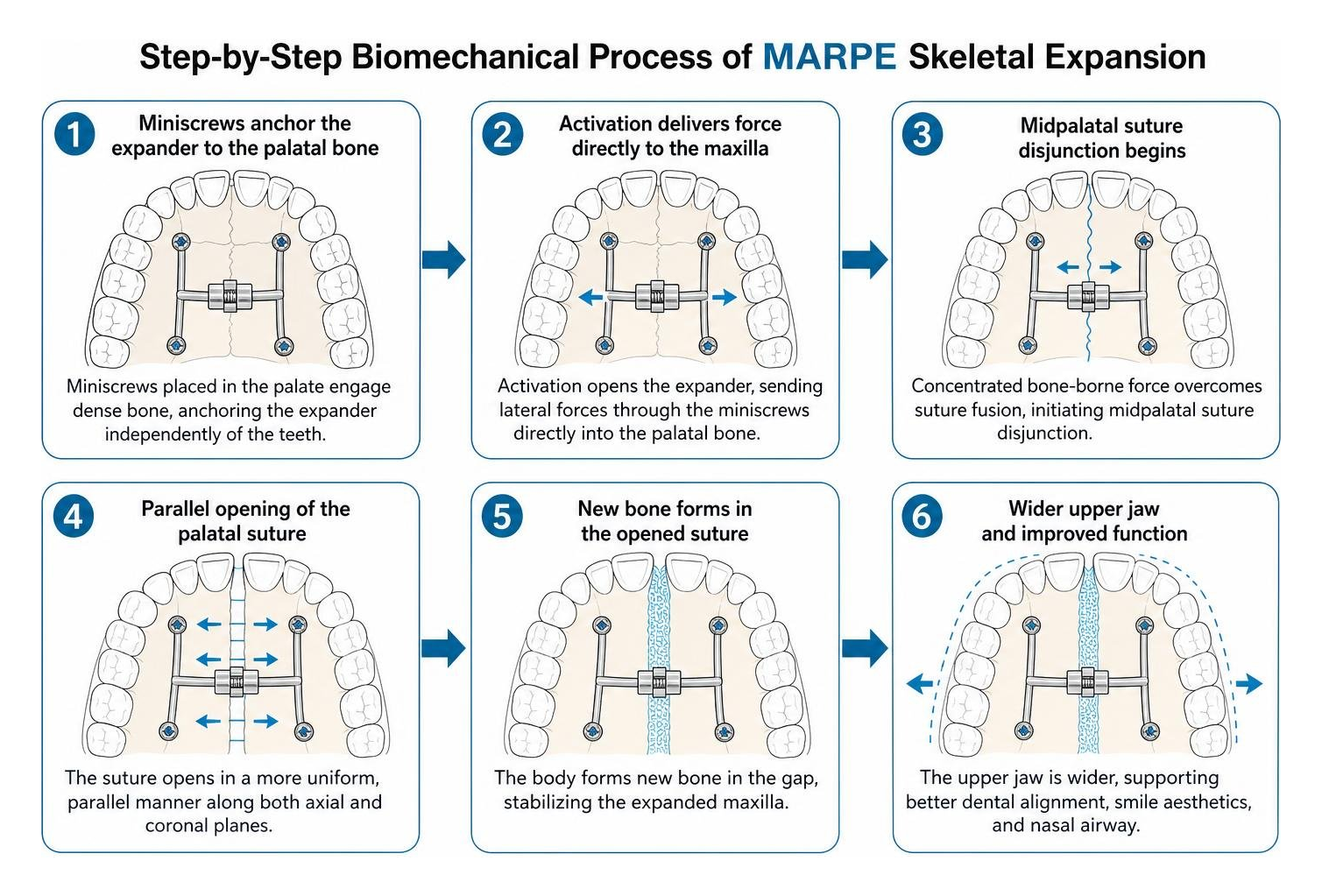
When reviewing palatal expander basics 101, the difference in mechanics becomes immediately apparent:
- Direct Force Application: Instead of pushing against molar crowns, activation forces travel through the miniscrews directly into the maxilla.
- Suture Disjunction: The rigid bone-borne design creates sufficient concentrated force to overcome interdigitated suture fusion, triggering midpalatal suture disjunction.
- Parallel Suture Opening: Conventional expanders often tilt outwards in a “V” shape. MARPE encourages a more uniform, parallel opening along both the axial and coronal planes of the palate.
- True Skeletal Widening: Research indicates that MARPE achieves substantial skeletal expansion. In prospective studies evaluating four-miniscrew MARPE appliances, patients gained a mean expansion of 5.94 mm at the first molar level, with an impressive 67.34% of that movement being true skeletal widening rather than dental tipping.
MARPE vs. Conventional Tooth-Borne Expanders and SARPE
Historically, adult patients with skeletal transverse deficiency had two choices: attempt conventional expansion (and risk severe dental tipping) or undergo Surgically Assisted Rapid Palatal Expansion (SARPE). Today, MARPE bridges this gap with an effective, minimally invasive alternative.
| Feature / Metric | Conventional Tooth-Borne Expander (e.g., Hyrax) | Miniscrew Assisted Rapid Palatal Expansion (MARPE) | Surgically Assisted Rapid Palatal Expansion (SARPE) |
|---|---|---|---|
| Anchorage Type | Tooth-borne (bands on molars/premolars) | Bone-borne or hybrid (miniscrews + molar rests) | Bone-borne or tooth-borne with surgical osteotomy |
| Skeletal Success Rate in Adults | Very low (primarily dental tipping) | High (overall success rate around 96%, ranging 68%–100%) | Near 100% |
| Maxillary Skeletal Expansion | 0.99 mm to 4.59 mm (predominantly in children) | 1.27 mm to 4.12 mm (effective in mature bone) | High (customizable via surgical cuts) |
| Nasal Width Increase | 0.11 mm to 2.46 mm | 0.31 mm to 2.90 mm (up to 3.29 mm nasal base width) | Significant nasal airway widening |
| Dental Tipping Risk | High (significant buccal tipping) | Very Low (up to 3–9x less tipping than Hyrax) | Low |
| Buccal Bone Thickness Impact | High risk of bone thinning and recession | Minimal reduction (~0.3 mm, clinically negligible) | Low dental risk; surgical recovery required |
| Invasiveness & Downtime | Non-invasive; zero surgical downtime | Minimally invasive; minor palatal insertion; no downtime | Inpatient/outpatient surgery under general anesthesia |
While traditional rapid palatal expansion offers a fast track to a broader smile with rapid palatal expanders in young children, adults attempting tooth-borne expansion often experience buccal cortical plate thinning, root resorption, and dental relapse.
Conversely, while surgical orthodontics remains necessary for severe craniofacial discrepancies or older adult cases with complete cranial suture fusion, MARPE successfully eliminates the need for operating room osteotomies in many young adults and late adolescents.
Clinical and Airway Benefits of Adult Palatal Expansion
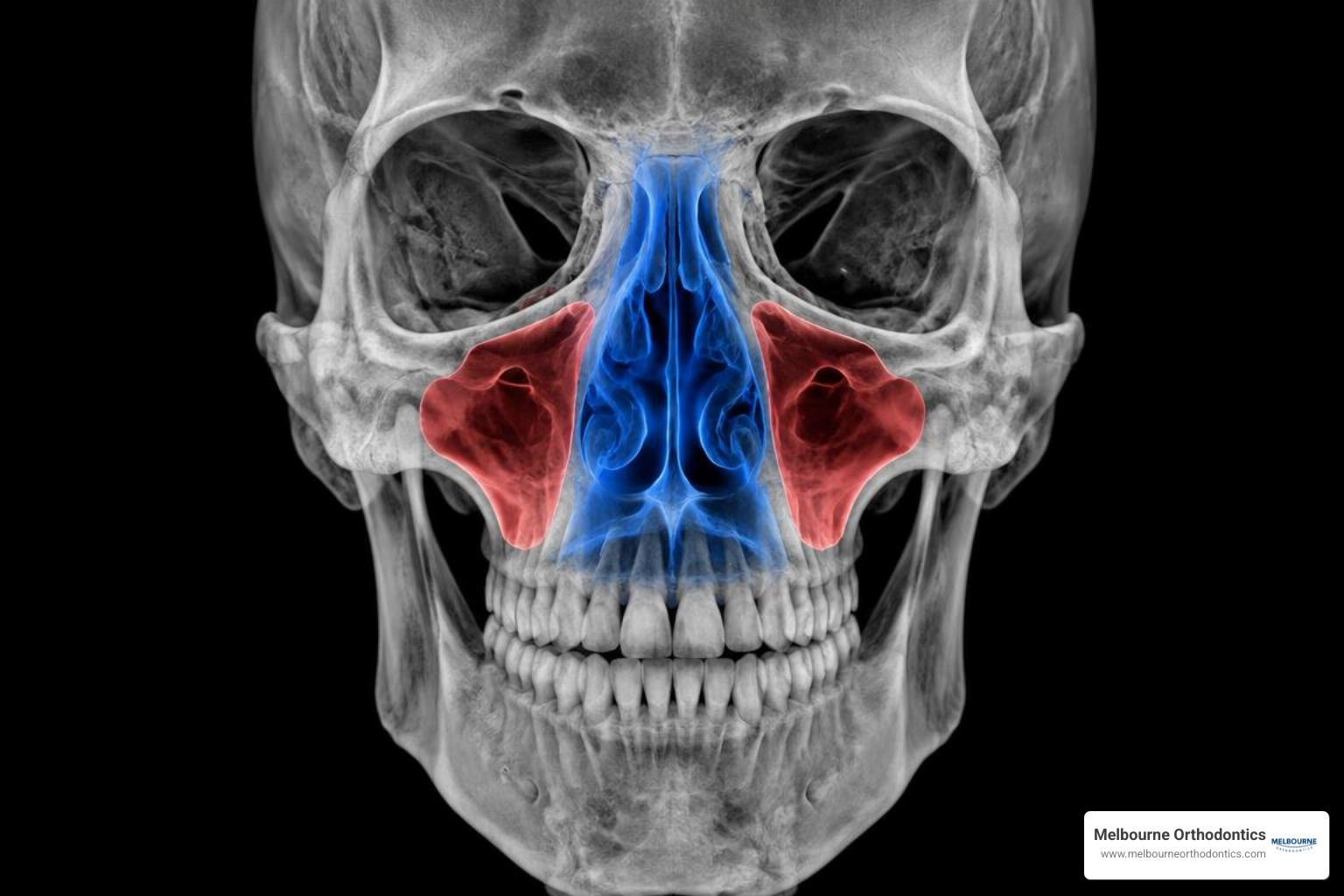
Expanding the palate does much more than simply align the teeth. Because the roof of the mouth serves as the floor of the nasal cavity, skeletal expansion directly impacts upper airway architecture:
- Increased Nasal Airway Dimensions: Studies demonstrate that following MARPE, average nasal base width increases by 3.29 mm and internal nasal cavity width increases by 1.81 mm.
- Improved Breathing Dynamics: By widening the nasal floor, airway resistance drops. Many patients with chronic nasal congestion or mouth-breathing habits report noticeable improvements in nasal breathing efficiency.
- Correction of Posterior Crossbites: Expanding the narrow upper jaw aligns the top teeth properly over the bottom teeth, resolving functional bite interferences and evening out jaw loading.
- Relief for Dental Crowding: Expanding the basal bone creates valuable space along the dental arch, making room for crowded teeth with expanders and frequently avoiding the need for permanent tooth extractions.
Facial Esthetics and Arch Symmetry
A constricted maxilla frequently produces large dark spaces at the corners of the mouth when smiling, known as dark buccal corridors. Widening the skeletal arch provides proper support for the facial soft tissues, filling the smile transversely for a fuller, broader, and more harmonious aesthetic.
Incorporating orthodontic appliances beyond braces early in an adult treatment plan sets a broad skeletal foundation, allowing subsequent clear aligners or fixed braces to achieve ideal aesthetic and functional coordination.
The Step-by-Step Treatment Process and Protocols
At Melbourne Orthodontics, delivering predictable skeletal expansion requires advanced diagnostic planning and precise clinical execution.
- 3D CBCT Imaging & Suture Assessment: We begin with high-resolution Cone-Beam Computed Tomography (CBCT). This allows us to evaluate the midpalatal suture’s stage of maturation (using the Angelieri classification system), measure palatal bone thickness, and map out safe zones for miniscrew placement away from dental roots and nerves.
- Custom Appliance Fabrication: A custom MARPE appliance is fabricated to match your exact palatal anatomy. Most successful adult protocols utilize a rigid four-screw design with indirect anchorage.
- Miniscrew Placement: Under simple local anesthesia right here in our office, four self-drilling, medical-grade titanium miniscrews (typically $ge$ 1.6 mm in diameter) are gently seated through the appliance into the palate to achieve bicortical anchorage. The procedure is comfortable, quick, and requires no incisions.
Daily Activation and Maintenance for Miniscrew Assisted Rapid Palatal Expansion
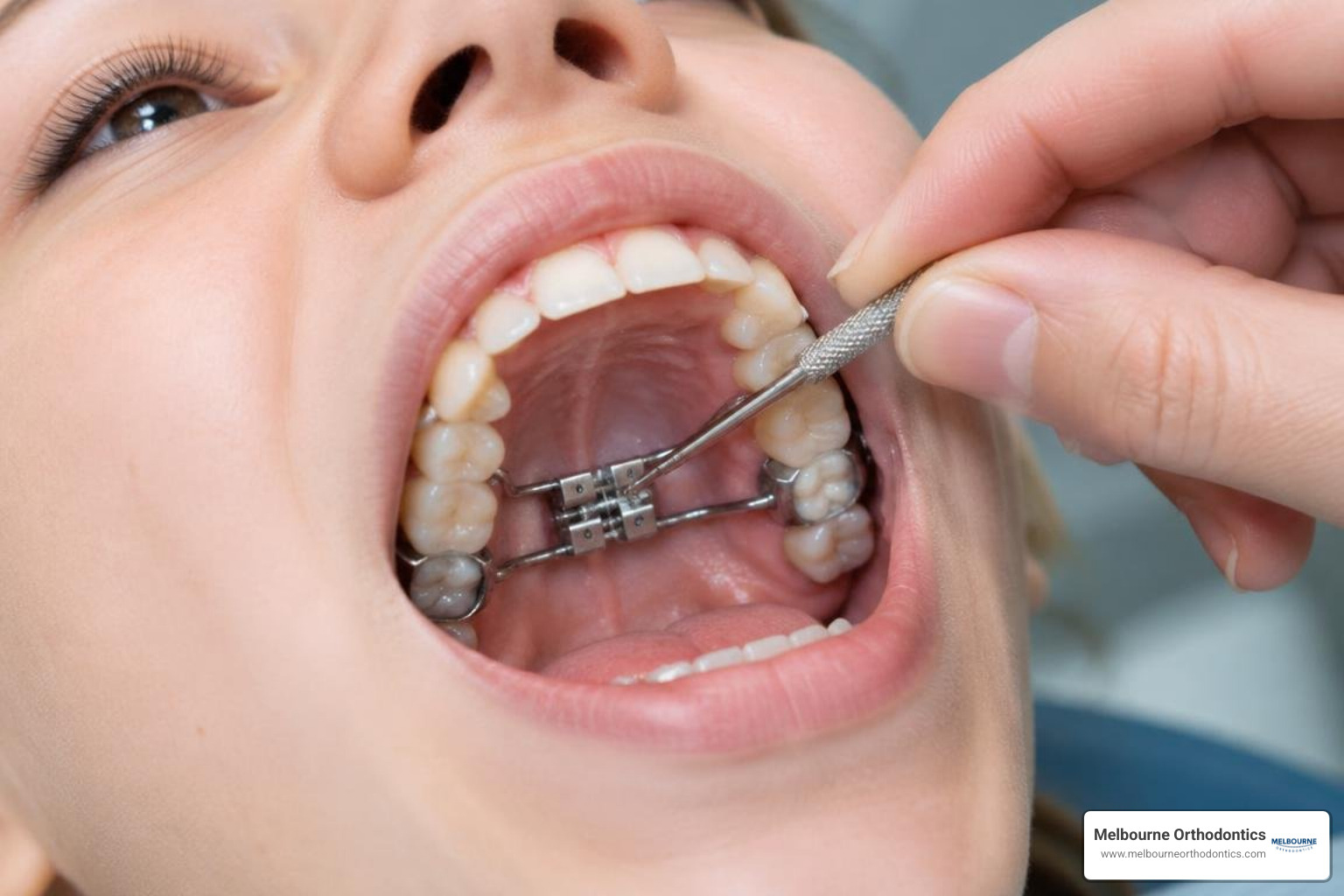
Once the appliance is seated, you will be guided through a simple daily activation protocol using a specialized key.
- Activation Frequency: Meta-analyses demonstrate that a steady, once-daily turn protocol (approximately 0.2 mm to 0.26 mm per day) yields superior skeletal expansion while minimizing dental tipping and soft-tissue irritation compared to aggressive multi-turn schedules.
- The “Gap” Phenomenon: After several days to a couple of weeks, a noticeable gap (diastema) usually opens between your two upper front teeth. Do not be alarmed—this is the classic clinical sign that the midpalatal suture has successfully separated! This space is temporary and will be closed later with braces or clear aligners.
- Retention Phase: Once the planned skeletal width is achieved, the appliance is locked in place for a minimum of 6 months. This retention period is crucial because it gives your body time for palatal bone remodeling and new bone ossification along the open suture line, ensuring lifetime stability.
- Daily Care and Elastics: Good oral hygiene around the miniscrews using an antimicrobial mouth rinse or water flosser keeps the surrounding tissues healthy. If your personalized treatment plan includes auxiliary mechanics, remember our recommendation that patients change their interarch elastics at least once a day to maintain consistent, effective corrective forces.
Frequently Asked Questions About Adult Palatal Expansion
What is the optimal age range for MARPE treatment?
While MARPE is effective across a range of mature patients, clinical studies show that predictability is highest in late adolescents and young adults under 30 years of age (achieving success rates between 80% and 90%+). Beyond age 30, midpalatal and circummaxillary sutures exhibit denser ossification and interdigitation, which may require customized force protocols or surgical assistance.
Does MARPE cause tooth tipping or root resorption?
Because MARPE uses bone-borne miniscrews, forces bypass the teeth and anchor directly into the skeletal framework. Clinical studies confirm that MARPE results in 3 to 9 times less dental inclination than traditional tooth-borne expanders. Premolar and molar root lengths show no statistically significant resorption, and buccal alveolar bone thickness experiences only a negligible, clinically undetectable change of roughly 0.3 mm.
How long does the retention phase last after expansion?
The active turning phase typically lasts around 4 to 6 weeks, but the appliance usually remains passively anchored in place for at least 6 months. This retention window allows new bone in the midpalatal suture to mature and strengthen, helping reduce the risk of relapse.
Achieving a Broader Smile and Clearer Breathing
Expanding an adult palate is no longer limited to invasive hospital surgeries or ineffective tooth-borne appliances. With modern miniscrew-assisted rapid palatal expansion, we can address skeletal crossbites, broaden narrow arches, create room for crowded teeth, and improve nasal airflow with predictable, non-surgical precision.
If you are curious whether your bite and airway can benefit from skeletal widening, visit our team at Melbourne Orthodontics in Melbourne, Florida and Indian Harbour Beach, Florida. Discover our full selection of appliances and let us help you achieve a healthier bite and a broader, more confident smile.