Mind the Gap Kiddo: A Parent’s Guide to Children’s Space Maintainers
Does Your Child Need a Space Maintainer After a Tooth Extraction?
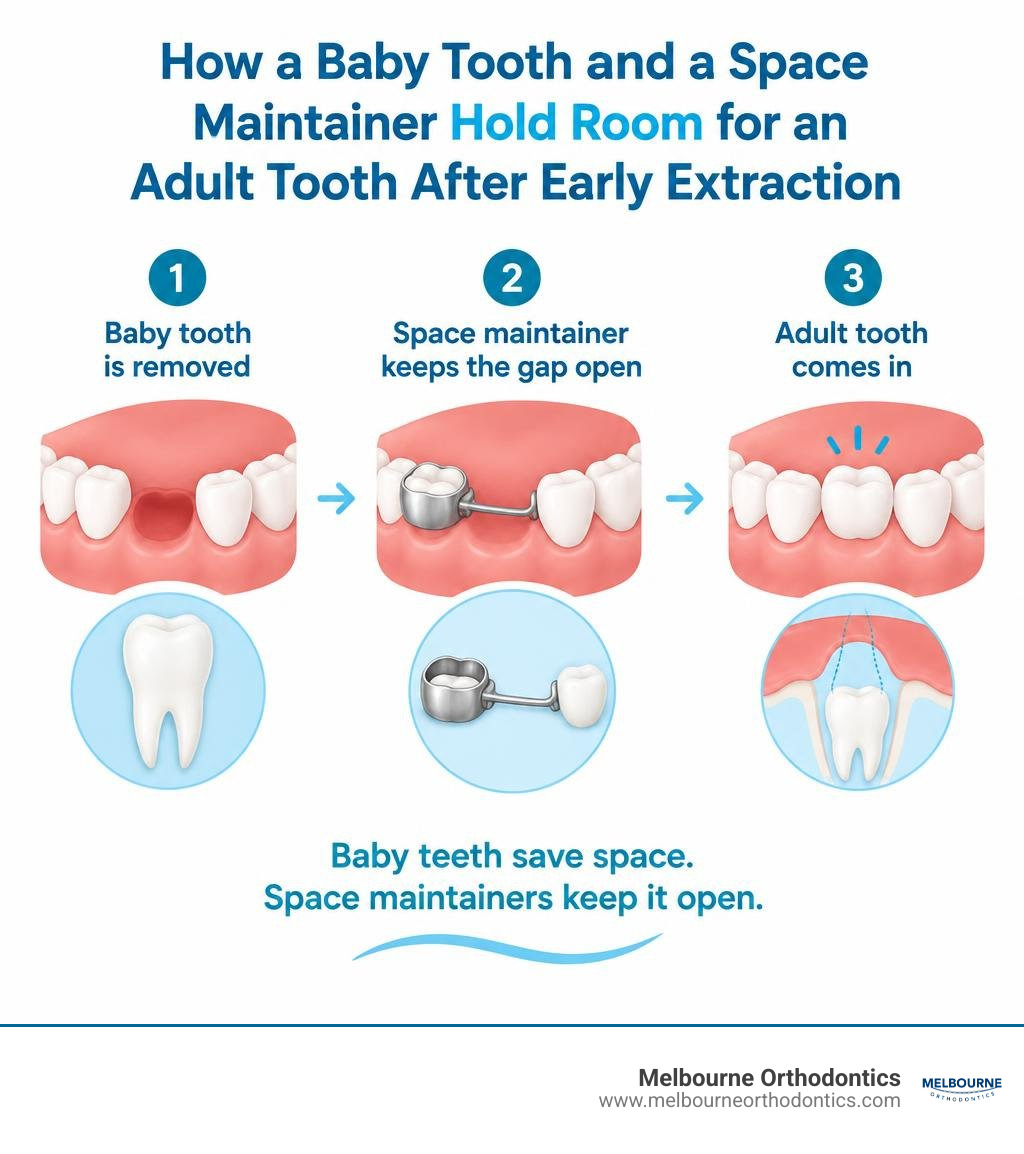
Sometimes, but not always. If a baby molar is removed well before the adult tooth is ready to come in, a space maintainer can hold the gap open so nearby teeth do not shift into it. Ask your child’s dentist about the need for one soon after the extraction. A baby tooth that was nearly ready to fall out may not need a spacer.
Baby teeth do more than help children chew. They also save room and help guide adult teeth into place. The right plan depends on which tooth was lost and how your child’s teeth are developing. For many families, spacers for a child’s teeth after an extraction become part of that plan, but the timing and type always depend on the individual case.
I’m Dr. Chad Reddick, an orthodontist at Melbourne Orthodontics with three years of specialized orthodontic training. When parents search for “spacers for teeth after extraction child,” I help them understand how early tooth loss may affect a growing smile.
Basic spacers for teeth after extraction child glossary:
Why Spacers for Teeth After Extraction in a Child Are Essential
When a young child loses a primary tooth to severe decay or physical trauma, many parents assume that because baby teeth eventually fall out on their own, an empty space poses no long-term threat. In clinical reality, primary teeth serve as the natural architectural blueprint for a child’s permanent smile. Research shows that roughly 20.8% of children aged 5 to 9 experience premature primary tooth loss before turning six years old. When that loss happens unexpectedly, preserving arch stability becomes vital for normal oral development.
The Natural Function of Baby Molars
Baby teeth—clinically known as primary or deciduous teeth—are far more than temporary placeholders. A child develops a full set of 20 primary teeth that begin emerging around 4 to 7 months of age and naturally exfoliate between ages 5 and 12. Among these, primary molars carry the heaviest structural responsibility. Interestingly, clinical data shows that primary molars account for 98.2% of all prematurely lost baby teeth, with the lower left first primary molar being the most frequently missing tooth.
Beyond chewing food and supporting clear speech articulation, deciduous molars maintain the precise perimeter of the jaw. They support healthy facial muscle tone and guide permanent premolars into their proper eruption tracks beneath the gums. When a primary molar is lost years ahead of schedule, the underlying permanent tooth bud loses its natural roadmap. Initiating early interceptive orthodontic treatment for kids ensures these vital spaces remain preserved, safeguarding developing jaw structures during critical growth windows.
How Premature Loss Causes Dental Space Collapse
The dental arch is dynamic. When a baby molar is extracted, the surrounding teeth do not simply sit quietly. Instead, natural forces cause neighboring teeth to tip, rotate, and drift into the open gap.
Clinical studies reveal that space closure begins almost immediately after an extraction:
- In the upper jaw, an extraction space measuring an average of 16.70 mm can rapidly narrow to 15.62 mm within just six months—a measurable space loss of over 1 mm.
- In the lower jaw, premature loss of a primary molar results in an average space loss of approximately 1.5 mm.
This rapid movement happens because permanent molars naturally drift forward (mesial drift), while primary canines and incisors often tip backward into the gap. Without proactive management, the space required for the permanent premolar collapses completely. This leaves the incoming adult tooth impacted beneath dense bone, pushed out of alignment (ectopic eruption), or severely crowded.
Seeking timely early orthodontic evaluation and treatment allows our team to monitor arch changes and intervene before preventable malocclusions require complex surgical exposure or permanent tooth extractions in adolescence.
Types of Pediatric Space Maintainers: Fixed vs. Removable
Space maintainers come in various designs depending on your child’s age, dental anatomy, behavioral readiness, and the number of missing teeth. These devices generally fall into two broad categories: fixed appliances (cemented directly to the teeth) and removable appliances.
Types of Fixed Spacers for Teeth After Extraction in a Child
Fixed appliances are the gold standard in pediatric space management because they remain securely in place 24/7 without relying on a child remembering to wear them. Whether dealing with single or multiple extractions, our comprehensive guide to dental spacers after extraction highlights how these custom appliances stabilize arch integrity.
Here is an overview of the most common fixed space maintainers used in pediatric dentistry:
- Band-and-Loop Maintainer: Designed for the premature loss of a single primary molar when the surrounding teeth have already erupted. A smooth stainless steel band wraps around the adjacent anchor tooth, and a custom wire loop spans the extraction gap to brace gently against the tooth in front.
- Crown-and-Loop Maintainer: Structurally identical to the band-and-loop, but utilized when the anchor tooth is significantly decayed or broken down. Instead of a simple metal band, a full stainless steel crown covers the abutment tooth to restore chewing strength while the welded loop maintains the space.
- Distal Shoe Maintainer: Used when a primary second molar is lost before the permanent six-year molar has erupted through the gums. A small metal extension rests beneath the gumline along the alveolar ridge, physically guiding the unerupted adult molar into its upright position.
- Lower Lingual Holding Arch (LLHA): A bilateral appliance used in the lower arch when multiple baby teeth are lost. Metal bands are cemented to the back permanent molars, connected by a heavy-gauge wire running along the inside (lingual) surface of the lower front teeth. This is typically placed after the permanent lower incisors have erupted.
- Nance Palatal Arch: A bilateral appliance for the upper jaw featuring bands on the upper molars connected by an archwire that rests against an acrylic button on the roof of the mouth, providing firm anchorage against mesial drifting.
- Transpalatal Arch (TPA): An upper-arch bilateral maintainer using a contoured wire that crosses directly over the palate without an acrylic button, keeping the molars from rotating or tipping inward.
| Appliance Name | Arch Position | Unilateral vs. Bilateral | Primary Clinical Indication |
|---|---|---|---|
| Band-and-Loop | Upper or Lower | Unilateral (Single side) | Loss of a single primary molar with erupted adjacent teeth |
| Crown-and-Loop | Upper or Lower | Unilateral (Single side) | Single molar loss when the anchor tooth requires a protective crown |
| Distal Shoe | Upper or Lower | Unilateral (Single side) | Primary second molar loss before the permanent first molar erupts |
| Lower Lingual Arch | Lower Arch | Bilateral (Both sides) | Multiple missing baby molars; preserves lower arch perimeter |
| Nance Palatal Arch | Upper Arch | Bilateral (Both sides) | Multiple missing upper molars; offers maximum palatal anchorage |
| Transpalatal Arch | Upper Arch | Bilateral (Both sides) | Bilateral upper molar stabilization and rotation prevention |
Removable and Modern Composite Maintainers
While fixed metal appliances are the traditional choice, modern orthodontics offers alternative materials and removable solutions based on individual clinical scenarios.
- Removable Hawley Appliances: Similar to orthodontic retainers, these appliances utilize acrylic bases with wire clasps and artificial acrylic teeth to hold space while restoring chewing function and aesthetics. However, removable appliances carry high rates of loss, breakage, and non-compliance in young children.
- Fiber-Reinforced Composite Resin (FRCR): An aesthetic, metal-free alternative bonded directly to adjacent teeth using dental composites. Clinical studies show FRCR space maintainers achieve success rates between 52.2% and 63.3% over 24 months, offering a single-visit solution that minimizes gum irritation.
- Prefabricated & 3D-Printed Space Maintainers: Modern digital workflows allow appliances to be customized and 3D-printed from biocompatible materials, or selected from prefabricated modular systems that report clinical success rates exceeding 90%.
Understanding the differences between pediatric and adult dental spacers helps parents see that while adult spacers prepare teeth for orthodontic bands or dental implants, pediatric appliances are uniquely designed to preserve space dynamically during active skeletal growth.
What to Expect: Placement, Daily Care, and Complications
Having a space maintainer placed is a comfortable, non-invasive process. The appliance is custom-sized, checked for proper fit, and cemented over the anchor tooth. Understanding home care helps ensure the appliance remains intact and trouble-free.
Caring for Spacers for Teeth After Extraction in a Child
Because fixed space maintainers must seat slightly below the gumline to achieve a firm mechanical grip, mild gum sensitivity and slight bleeding during brushing are completely normal for the first 2 to 3 days.
To protect the appliance and keep gum tissues healthy, follow these essential guidelines:
- Gentle, Consistent Hygiene: Brush the appliance thoroughly twice a day using a soft-bristled toothbrush. Light bleeding during the initial healing window will resolve as the gum tissue tightens around the band.
- Dietary Restrictions: Avoid sticky, chewy, and hard foods (taffy, gummy candies, caramel, chewing gum, hard suckers, and ice). These foods can break the cement seal or bend the supportive wire framework.
- No Picking or Prying: Remind your child not to push on the wire with their tongue or pull at the bands with their fingers. Constant upward or downward pressure loosens dental cement over time.
- Post-Extraction Clot Protection: If the maintainer is placed shortly after an extraction, avoid drinking through straws, using sippy cups, or using pacifiers for the first 24 hours. The negative pressure created by sucking can dislodge the blood clot and prolong healing.
- Comprehensive Care Note: If your child transitions to active phase orthodontic movement where interarch elastics are prescribed, patients are recommended to change their interarch elastics at least once a day to ensure consistent elastic force.
For parents who want a deeper look at orthodontic preparation tools, our guide on orthodontic spacers and interdental bands explains how different spacing appliances function during active orthodontic care.
Managing Common Complications and Failure Rates
No dental appliance is indestructible. Understanding how and why space maintainers fail allows parents to spot minor issues before they become dental emergencies.
- Decementation (Cement Breakdown): Research indicates that decementation is the leading cause of appliance failure, affecting roughly 22.4% of fixed space maintainers and up to 60% of bilateral appliances over extended follow-ups. Baby tooth enamel has a unique “prism-free” outer structure that naturally provides lower adhesive bonding strength than adult teeth. Chewing sticky treats or normal moisture during placement can accelerate cement washout.
- Wire Flexion and Distortion: Chewing on hard foods or pens can bend the wire loop (noted in roughly 28% of cases), causing it to press painfully into the gum tissue or block the adult tooth underneath.
- Plaque Accumulation: Fixed appliances introduce extra ledges where food can catch. Without diligent brushing, plaque can accumulate around the band, leading to localized gingival inflammation or enamel demineralization.
Regular checkups every six months allow our clinical team to inspect the cement seal, evaluate wire positioning, and take periodic digital X-rays to check underlying tooth development.
Frequently Asked Questions About Space Maintainers
How long does a child need to wear a space maintainer?
A space maintainer stays in place until the successor permanent tooth is structurally ready to erupt. Using routine dental X-rays, we monitor the permanent tooth’s root development.
Once the permanent tooth has formed approximately two-thirds of its adult root structure and begins breaking through the alveolar bone, the space maintainer has successfully fulfilled its purpose. Removing the appliance is a quick, completely painless chairside procedure where the band is gently uncrimped and the residual cement polished away.
Does every extracted baby tooth require a spacer?
No. Every tooth loss does not automatically necessitate an appliance. For instance, premature loss of front baby teeth (incisors) rarely causes space loss because the surrounding jaw structures do not push forward in that area.
Similarly, if an X-ray demonstrates that the underlying permanent tooth is already piercing the gumline, a spacer is unnecessary. We evaluate individual leeway space, patient age, dental hygiene, and overall bite alignment before recommending an appliance.
What should I do if my child’s space maintainer falls out or becomes loose?
If an appliance loosens or dislodges completely:
- Remove the Appliance Carefully: If the spacer is floating loose, take it out of your child’s mouth to prevent accidental swallowing or airway obstruction.
- Store It Safely: Rinse the appliance and place it in a clean, sealed container or plastic bag.
- Do Not Attempt DIY Adjustments: Never try to bend the appliance or glue it back into place with household adhesives.
- Call Our Office Promptly: Contact our team to schedule an appointment. In most cases, if the appliance remains undamaged, we can simply clean the tooth and re-cement the original spacer within minutes.
Conclusion
Baby teeth provide the essential foundation for a lifetime of healthy smiles. When early extractions become unavoidable, space maintainers offer a reliable, proactive approach to keeping dental arches open and preventing costly, extensive orthodontic corrections down the road.
At Melbourne Orthodontics, we take pride in delivering compassionate, patient-focused early orthodontic care led by Dr. Chad Reddick. Whether you live in Melbourne, Florida or Indian Harbour Beach, Florida, our experienced team is here to guide your child’s dental development at every step.
If your child recently had a baby tooth removed or you want clear answers about clearing up the confusion about dental spacers, reach out to schedule an early orthodontic consultation with us today.