Everything You Need to Know About Spacers and Interdental Bands
How Braces Rubber Bands Between Teeth Create Space
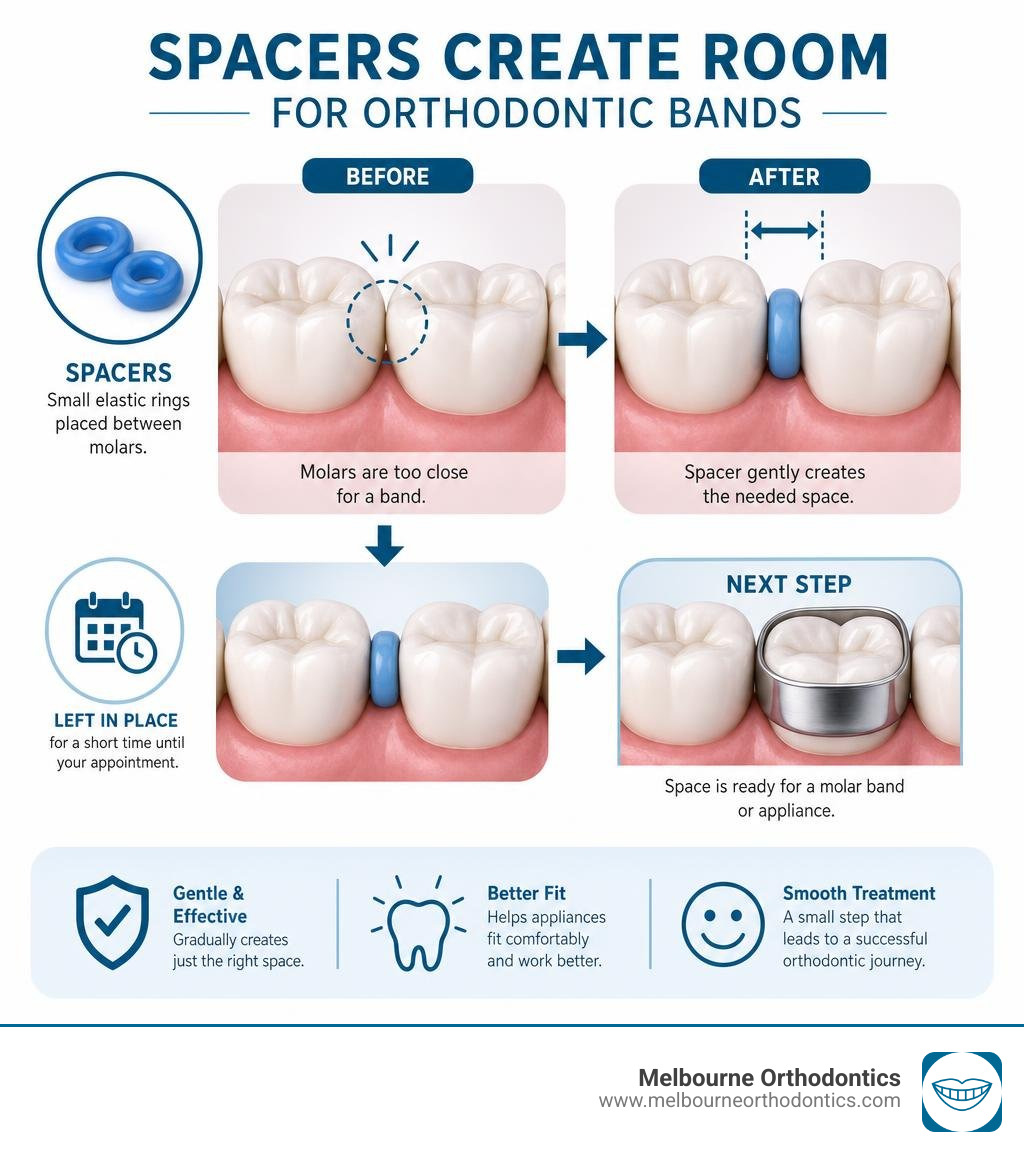
Braces rubber bands between teeth are usually orthodontic spacers, also called separators. These tiny, latex-free elastic rings sit between tightly touching molars for a short time. Their job is simple: create enough room for your orthodontist to place a molar band or an appliance such as a palatal expander.
Spacers are different from the elastics that hook between upper and lower braces to correct a bite. With spacers, brush normally but do not floss where the spacer sits, avoid sticky or chewy foods, and do not try to remove it yourself. If you wear upper-to-lower interarch elastics later in treatment, change them at least once a day or as directed by your orthodontist.
A little pressure or soreness is common for the first day or two. If a spacer falls out shortly before your appointment, it may mean the needed space has already formed, but call your orthodontist if you are unsure.
At Melbourne Orthodontics, serving patients in Melbourne, Florida and Indian Harbour Beach, Florida, our team helps children, teens, and adults understand each stage of care, including braces rubber bands between teeth and the role they play before bands or expanders are placed.
Understanding Braces Rubber Bands Between Teeth: Spacers vs. Elastics
When patients mention orthodontic bands, confusion often arises because elastic materials serve several distinct functions during treatment. The small rings wedged directly between your back teeth are known clinically as separators or spacers. They do not connect upper and lower jaws, nor do they hold wires into brackets. Instead, their sole function is interdental preparation.
In orthodontic care, back molars often anchor custom appliances, such as palatal expanders or sturdy molar bands (metal rings cemented around the tooth). Because adult and adolescent molars are naturally held tight by interproximal contact points, sliding a custom metal ring around them without preparation can be uncomfortable or technically impossible. Separators gently push adjacent teeth a fraction of a millimeter apart to make room.
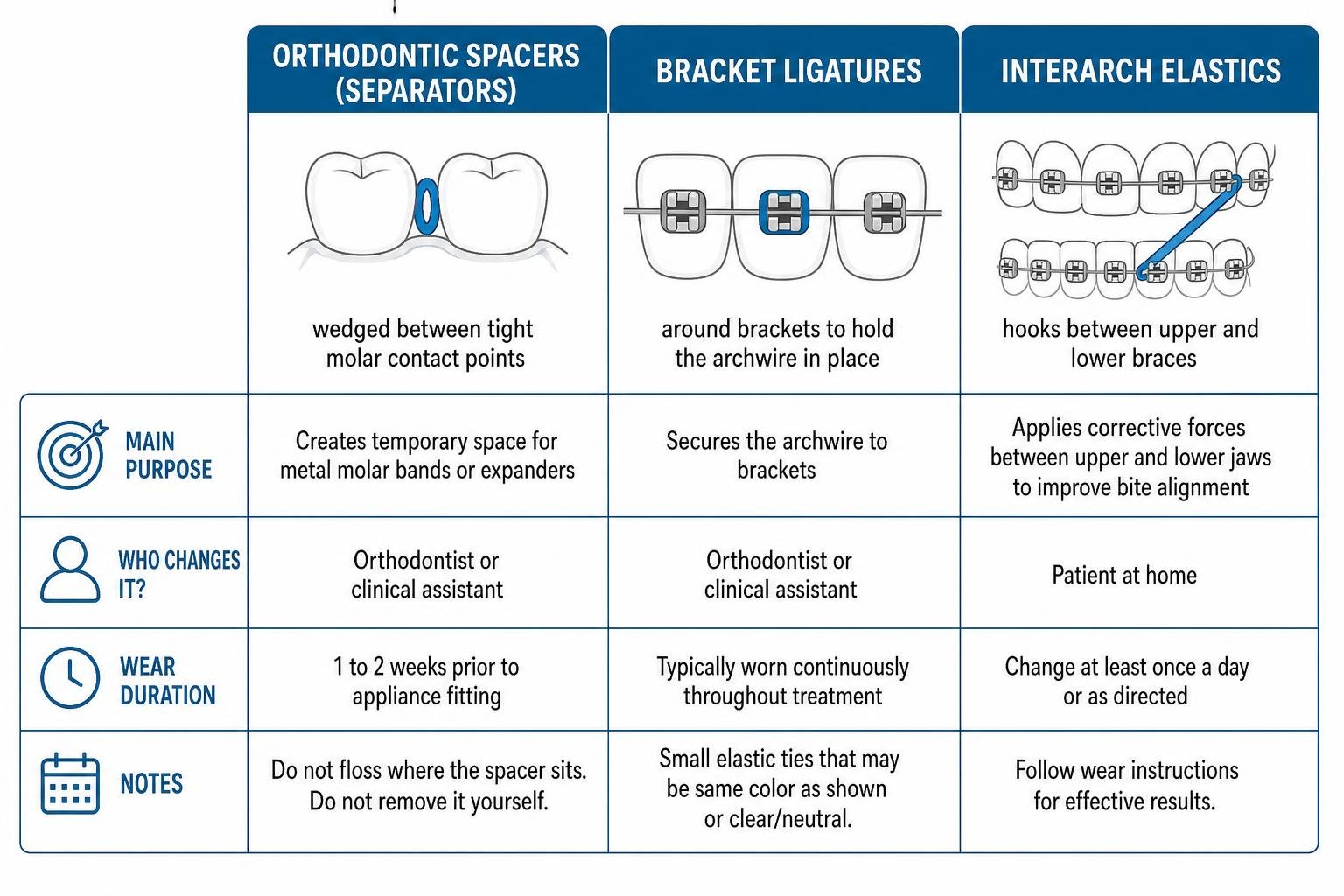
To help clarify the differences between these tools, here is a breakdown of the three main types of elastics used in treatment:
| Elastic Type | Where It Is Placed | Main Purpose | Who Changes It? | Wear Duration |
|---|---|---|---|---|
| Orthodontic Spacers (Separators) | Wedged between tight molar contact points | Creates temporary space for metal molar bands or expanders | Orthodontist or clinical assistant | 1 to 2 weeks prior to appliance fitting |
| Ligatures (O-Rings / Color Ties) | Stretched directly over individual brackets | Holds the archwire securely within the bracket slot | Orthodontist at adjustment visits | Changed every 4 to 8 weeks |
| Interarch Elastics (Rubber Bands) | Hooked from upper brackets to lower brackets | Corrects jaw alignment, overbites, underbites, and crossbites | Patient (changed at home) | Changed at least once a day, worn 20–22+ hours daily |
Why Orthodontists Place Braces Rubber Bands Between Teeth
The primary mechanical goal of placing orthodontic tooth separators between molars is gentle, continuous lateral pressure. Natural teeth are suspended in the alveolar bone by the periodontal ligament (PDL), a fibrous network acting as a biological shock absorber. When a latex-free rubber ring is stretched and wiggled between two tightly touching teeth, it constantly attempts to contract back to its original circular shape.
This steady recoil pushes the contact surfaces of the teeth apart. Understanding this step helps clarify what to expect when you get your braces on, as preparing the back teeth is frequently one of the very first physical milestones in Phase 1 or comprehensive orthodontic therapy.
How Separators Differ from Ligatures and Interarch Bands
It is helpful to distinguish spacers from the other elastics you will encounter:
- Ligature Ties: These tiny colored rings secure the metal archwire into each bracket slot. To learn more about how they secure wires, see why orthodontists put tiny rubber bands around braces brackets.
- Interarch Elastics: These are removable elastics hooked from top teeth to bottom teeth to direct specific force vectors for bite correction. Patients remove them to eat or brush and must change their interarch elastics at least once a day (and frequently up to 3–4 times daily) to maintain proper tension.
- Interdental Spacers: These remain seated between teeth 24 hours a day for a short window (typically 7 to 14 days) and are removed exclusively by your clinical team.
What to Expect When Wearing Orthodontic Spacers
Having a separator placed is a quick, needle-free procedure. Your orthodontic assistant stretches the small elastic using dental floss or a specialized plier tool, threading it below the contact point of the molars.
Once seated, the sensation feels remarkably similar to having a tough piece of food, like a popcorn hull or piece of meat, caught firmly between your teeth. While your tongue may naturally want to explore the new object, leaving the spacer undisturbed ensures it performs its job without slipping out. Establishing proper spacing directly supports long-term bite alignment and daily comfort throughout your treatment journey.
Discomfort and Adaptation Timeline
Mild discomfort or tooth tenderness is normal after spacers are placed. As continuous pressure stimulates the periodontal ligament, inflammatory mediators initiate temporary biological remodeling to allow micro-movement.
- First 2 to 4 Hours: You will primarily notice physical pressure or an awkward chewing sensation.
- 24 to 48 Hours: Discomfort typically peaks during this window. Chewing firm foods may feel tender because the surrounding nerve fibers are sensitive to vertical pressure.
- Day 3 and Beyond: Tenderness subsides significantly as teeth shift and adapt to the elastic.
Over-the-counter pain relievers taken according to package instructions can help manage initial soreness. Warm salt-water rinses (half a teaspoon of salt in a glass of warm water) also soothe sensitive gum tissues. Balancing bite forces properly protects oral structures; exploring the connection between orthodontics and TMJ highlights how foundational alignment steps prevent chronic joint strain.
Dietary Guidelines and Foods to Avoid
Protecting your spacers requires a few temporary adjustments to your daily meals. Eating sticky or excessively dense foods can dislodge separators prematurely, setting back your preparation timeline. Correcting complex bites—as outlined in our guide on types of malocclusion and how they can be treated—relies on keeping every appliance component secure.
Avoid these items while wearing spacers:
- Chewing gum of any variety
- Sticky candies (taffy, caramel, gummy bears, tootsie rolls)
- Hard candies or ice cubes
- Dense, chewy breads (bagels, hard pretzels, tough crusts)
- Tough meats (beef jerky, thick steak)
Instead, choose softer foods during the first couple of days, such as smoothies, pasta, scrambled eggs, yogurt, soups, and mashed potatoes.
Daily Oral Hygiene and Spacer Maintenance
Maintaining excellent oral hygiene around your separators prevents localized gingival inflammation. Plaque easily accumulates around orthodontic hardware, making diligent cleaning essential for long-term health, as detailed in braces and beyond: the journey to a lifelong healthy smile.
Caring for Braces Rubber Bands Between Teeth at Home
When brushing, use a soft-bristled toothbrush to clean around the chewing surfaces, sides, and gumlines of your molars. Gentle circular motions clear plaque without snagging the band.
Follow these essential rules while spacers are active:
- Do not floss between teeth that have spacers. Flossing in those specific contact points will catch the rubber ring and pull it out. You should continue to floss all other teeth normally.
- Do not pick at the bands. Avoid using toothpicks, fingernails, or tongue pressure to dislodge the elastic.
- Maintain your interarch routine if applicable. If your treatment plan includes interarch bite elastics, remember why you have to wear your rubber bands consistently, and make sure to change those elastics at least once a day to prevent force decay.
What to Do If a Spacer Falls Out Early
Spacers naturally loosen as they create adequate interdental clearance. If a rubber band between your teeth falls out on its own:
- A Few Days Before Your Appointment: This often indicates that the separator has completed its job and enough physical room has opened up between your teeth. Usually, the molar band or expander will slide into place without needing an extra visit.
- Within the First 48 Hours: If the band dislodges almost immediately after placement, the teeth may not have opened up enough.
- What You Should Do: Contact our clinical desk. We will check your upcoming schedule and let you know if you should stop by for a quick replacement or simply proceed directly to your scheduled banding visit.
Frequently Asked Questions About Orthodontic Bands and Spacers
How long do rubber spacers need to stay between teeth?
Orthodontic separators generally stay between teeth for 7 to 14 days. This short duration provides ample time for the periodontal ligament to adapt and create roughly 0.5 mm of space without allowing teeth to drift undesirably.
Do rubber band spacers hurt more than braces?
Pain is subjective, but many patients describe spacers as a feeling of pressure or having food stuck between their teeth rather than sharp pain. The tenderness peaks in the first 48 hours and is comparable to the initial soreness experienced when braces wires are first adjusted.
When should I call the orthodontist about my spacers?
You should call your orthodontic office if:
- A spacer falls out within the first 1 to 3 days after placement.
- You experience severe or worsening pain that is not relieved by over-the-counter pain medications.
- The rubber ring slides completely below your gumline and is no longer visible.
- You notice unusual swelling, severe bleeding, or signs of localized allergic irritation.
Conclusion
Interdental spacers are a brief but vital stepping stone in your orthodontic care. By temporarily resting between your back molars, these small rubber rings make fitting molar bands and expanders comfortable, smooth, and precise. Protecting them with smart food choices, gentle brushing, and leaving them alone ensures your smile transformation stays on schedule.
To understand how other orthodontic elastics will shape your smile later in treatment, take a look at what do orthodontic elastics do?. If you ever have questions about your separators or need guidance during care, our team at Melbourne Orthodontics in Melbourne, Florida and Indian Harbour Beach, Florida is always here to support your journey toward a healthy, radiant smile.