A – Z Guide to Early Orthodontic Treatment for Kids
Understanding Early Orthodontic Treatment and How It Differs from Regular Braces
Many parents naturally wonder why an orthodontist would evaluate a child who still has a mouth full of baby teeth. The distinction lies in the fundamental difference between moving established teeth and guiding developing bone.
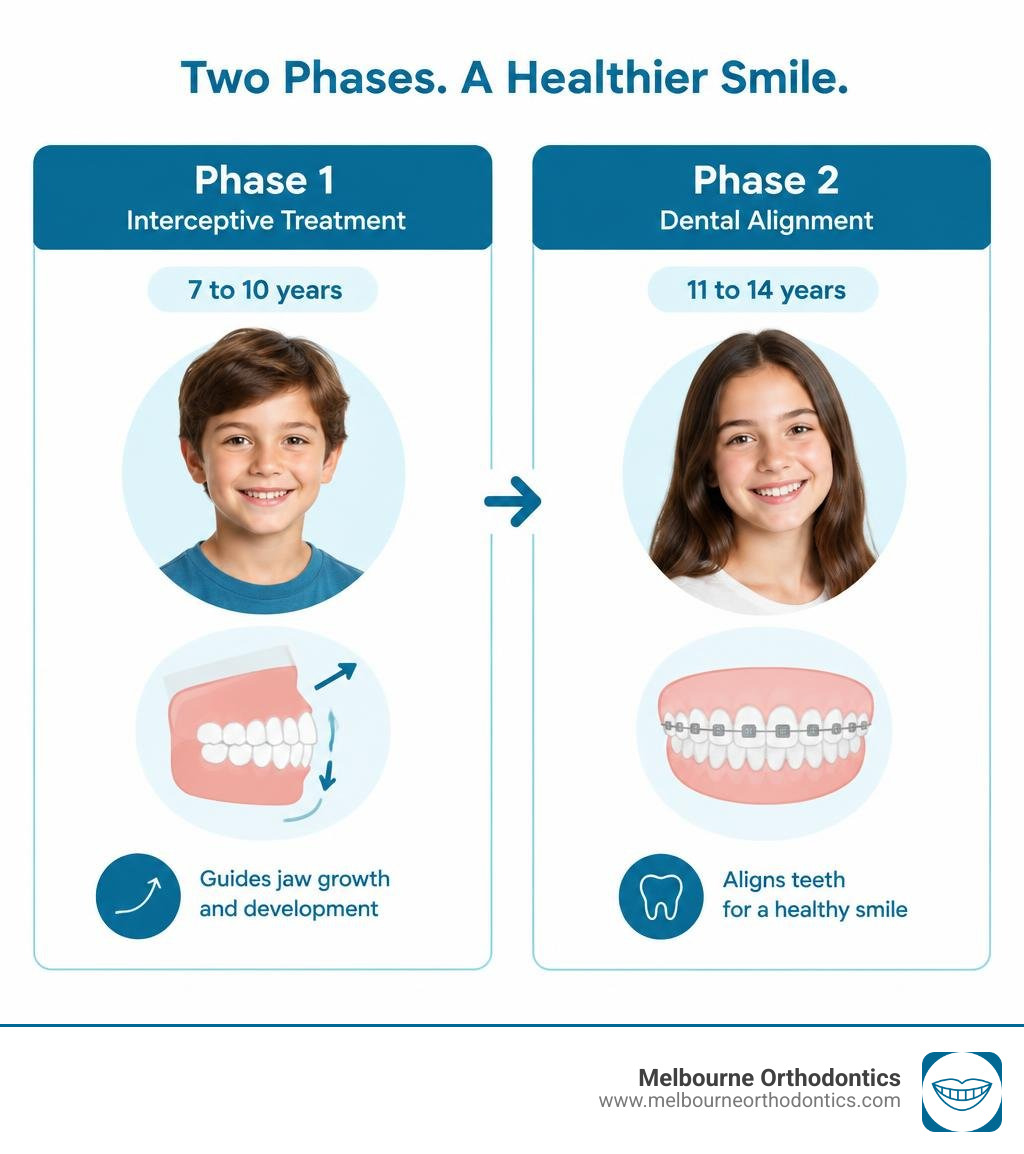
Regular braces—often referred to as comprehensive or Phase 2 orthodontics—focus primarily on moving permanent teeth into ideal aesthetic alignment and perfecting the final bite. This comprehensive stage typically occurs during early adolescence (ages 11 to 14), once all or nearly all primary teeth have naturally exfoliated.
Early orthodontic care, also known as Phase 1 or interceptive orthodontics, takes place much earlier—usually between the ages of 6 and 9, while a child is in the active mixed dentition stage. Instead of striving to align every single tooth perfectly, early intervention focuses on the foundational architecture of the mouth. We harness active childhood growth spurts to reshape narrow dental arches, modify jaw proportions, eliminate functional bite interferences, and clear eruption pathways for oncoming permanent teeth.
| Feature | Phase 1 Interceptive Treatment | Phase 2 Comprehensive Orthodontics |
|---|---|---|
| Typical Age Range | 6 to 9 years (mixed dentition) | 11 to 14+ years (permanent dentition) |
| Primary Objective | Guide skeletal jaw growth, manage arch width, and eliminate bite interferences | Align all adult teeth, correct micro-rotations, and fine-tune the final bite |
| Common Appliances | Palatal expanders, space maintainers, partial braces, habit appliances | Full upper and lower braces or clear aligners |
| Treatment Duration | Concise (typically 9 to 15 months) | Comprehensive (typically 18 to 24 months) |
| Dentition Present | Mix of primary (baby) and secondary (adult) teeth | Full or near-complete set of permanent teeth |
Core Goals and Phases of Early Orthodontic Treatment
Phase 1 care operates on a simple philosophy: prevent small developmental deviations from morphing into complex, structural deformities. When considering why should I invest in interceptive orthodontics?, parents often discover that targeted early care creates an optimal biological environment for future facial growth.
Interceptive protocols are designed as concise, targeted interventions rather than indefinite procedures. We aim for active treatment windows lasting between 9 and 15 months. Keeping Phase 1 concise preserves a child’s compliance, prevents orthodontic fatigue, and protects enamel hygiene.
Once the primary skeletal or dental obstacle is resolved, appliances are removed, and the child enters a resting or observation stage. During this period, we monitor the natural eruption of the remaining permanent teeth before determining whether a shorter, simpler Phase 2 course of braces is required.
The Clinical Rationale Behind the Age 7 Orthodontic Evaluation
The American Association of Orthodontists (AAO) establishes age 7 as the benchmark for a first screening. When parents ask when should my child get braces?, they are often surprised to learn that an evaluation at age 7 rarely leads to immediate braces.
By age 7, several critical dental milestones have occurred:
- The first permanent adult molars have erupted, establishing the foundational “back bite” and anteroposterior jaw relationship.
- The upper and lower central and lateral incisors begin emerging, revealing potential space discrepancies, crossbites, and severe crowding.
- Craniofacial development is pliable, meaning jaw bones have not yet fully calcified or fused at the sutures, allowing for gentle orthopedic modification.
This evaluation establishes a clear developmental baseline. It allows us to distinguish between normal transitional growth quirks and true skeletal imbalances that require early intervention.
Key Orthodontic Issues That Benefit Most from Early Intervention
Not every bite irregularity warrants immediate intervention. However, certain severe skeletal discrepancies and functional obstacles benefit significantly from early interceptive mechanics. Reviewing the common types and classes of malocclusion helps clarify which specific conditions demand timely care.
Posterior Crossbites and Maxillary Constriction
A posterior crossbite occurs when the upper jaw is too narrow relative to the lower jaw, causing the upper back teeth to bite inside the lower back teeth. In primary dentition, posterior crossbites carry a prevalence of 8% to 22%.
When a child has a constricted maxilla, they often shift their lower jaw laterally to one side to chew comfortably. Over time, this functional shift can cause permanent skeletal remodeling, resulting in facial asymmetry, uneven joint wear, and unilateral dental wear.
A Rapid Palatal Expander (RPE) is often used to manage posterior crossbites. By anchoring the expander to the primary molars, we can gently widen the upper jaw while the midpalatal suture is still responsive. After active expansion, usually over 4 to 6 weeks, we maintain the result passively for 6 to 12 months to support bone stabilisation and reduce the risk of relapse or uneven jaw development.
Skeletal Class III Underbites and Maxillary Retrusion
A Class III malocclusion—commonly presenting as an underbite where the lower teeth protrude past the upper teeth—is one of the most critical conditions requiring early orthopedic correction. Approximately 60% of Class III patients present with a retrusive, underdeveloped maxilla rather than an excessively large mandible alone.
Biological timing is paramount here. Skeletal Class III discrepancies are typically treated during Phase 1, or interceptive treatment, between ages 7 and 10, when growth can still be guided and appliances may help encourage better jaw balance before comprehensive adolescent orthodontic treatment.
Early protraction protocols frequently utilize a reverse-pull facemask anchored to an expander or bonded cleats on the deciduous molars and canines. When utilizing interarch elastics for orthopedic traction, we recommend that patients change their interarch elastics at least once a day to maintain continuous, effective force levels.
Following active protraction, taking a follow-up cephalometric X-ray 2 to 4 years later allows us to track the Growth Treatment Response Vector and confirm long-term jaw stability.
Arch Length Discrepancies, Severe Crowding, and Serial Extractions
Severe tooth-size-to-jaw-size disharmony can cause erupting permanent teeth to become blocked out or impacted within the bone. In cases of extreme arch length deficiency, interceptive eruption guidance—including serial extractions—serves as an evidence-based tool to guide teeth into healthier positions.
Serial extraction involves the strategic, timed removal of specific baby teeth (and occasionally first premolars later) to clear a natural pathway for permanent incisors and canines. Utilizing this method preserves the leeway space—the valuable size difference between primary molars and the smaller permanent premolars that replace them.
By guiding teeth naturally into alignment as they erupt, serial extractions alleviate severe crowding, reduce the risk of gingival stripping on blocked-out incisors, and shorten subsequent comprehensive teenage braces.
Identifying Early Warning Signs and Treatment Appliances
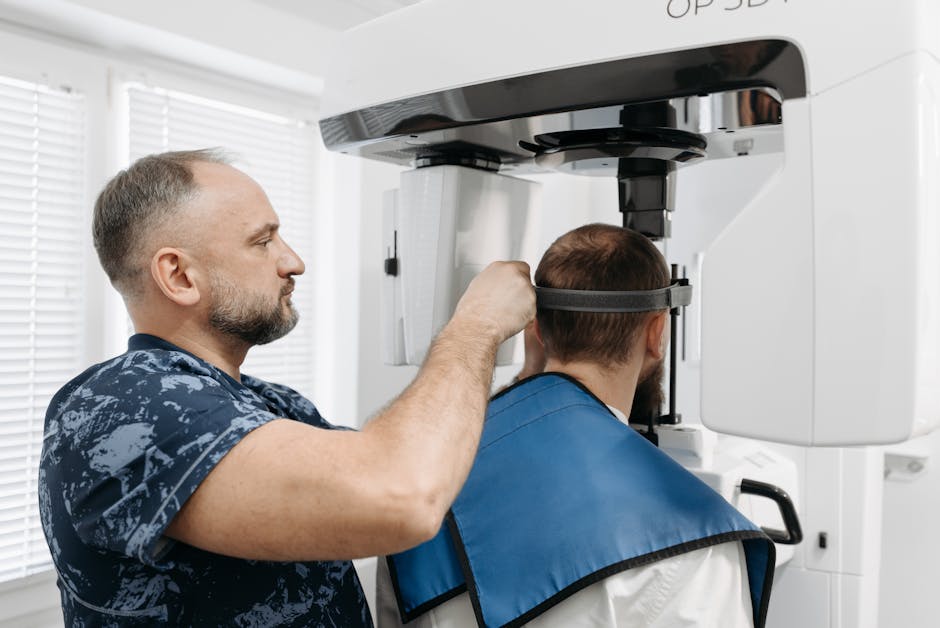
While subtle jaw imbalances require professional diagnostic imaging, parents can observe several clear developmental signals at home.
Common Indicators Parents Can Spot at Home
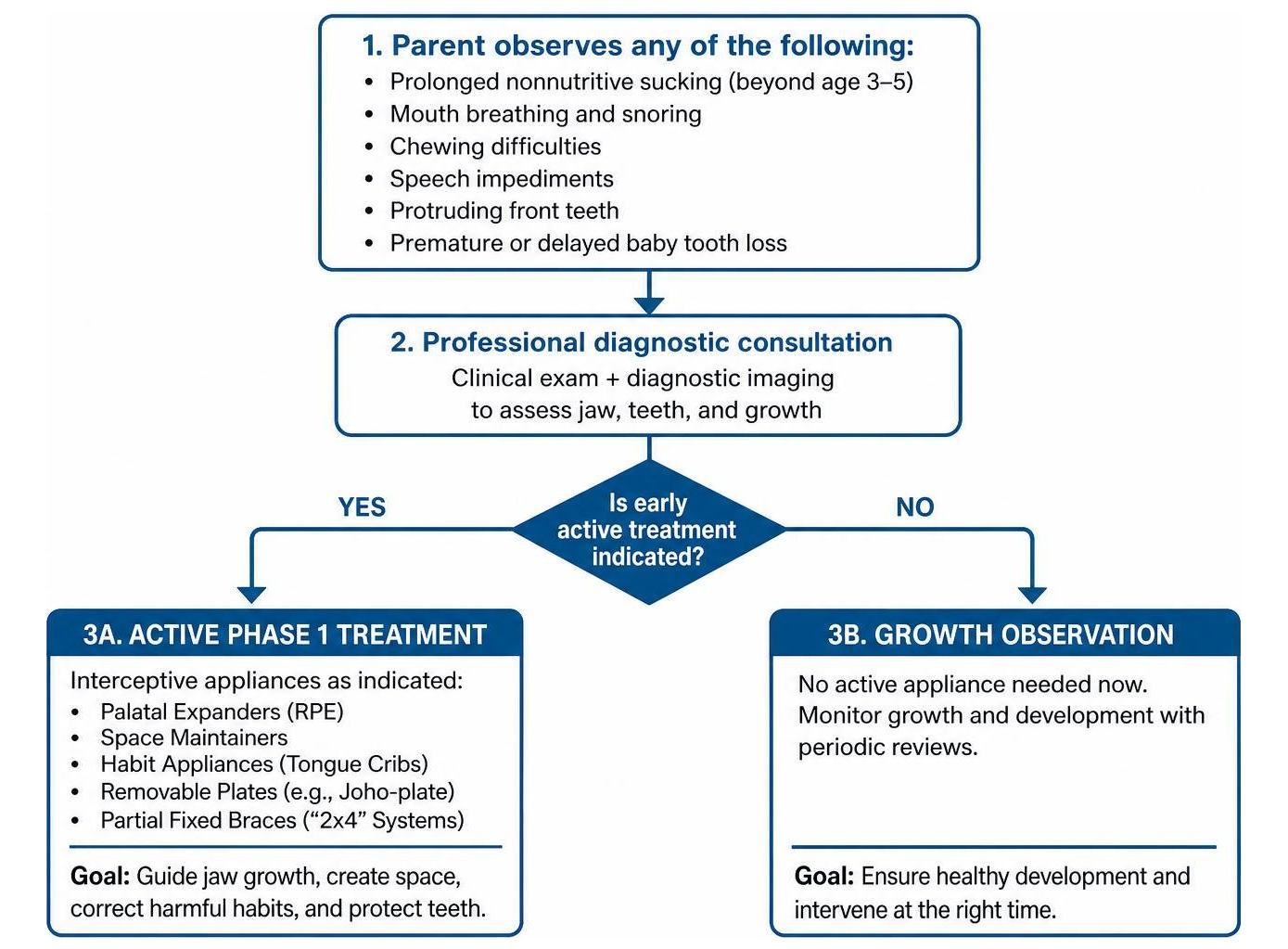
Reviewing early signs your child may need orthodontic treatment helps parents identify when a growth check is appropriate:
- Prolonged Nonnutritive Sucking: Thumb, finger, or pacifier habits persisting beyond age 3 to 5 can narrow the dental arch and create an open bite.
- Mouth Breathing and Snoring: Chronic mouth breathing, often associated with enlarged tonsils or narrow palates, can encourage an abnormal resting tongue posture and alter facial growth.
- Chewing Difficulties: Shifting the jaw to one side when biting down or struggling to chew foods efficiently.
- Speech Impediments: Persistent lisps or difficulty articulating certain sounds due to front teeth failing to meet.
- Protruding Front Teeth: Upper front teeth that flare significantly outward (“buck teeth”), leaving them vulnerable to accidental sports or playground trauma.
- Premature or Delayed Baby Tooth Loss: Losing baby teeth unusually early due to decay or injury, or baby teeth lingering well past their normal shedding age.
Interceptive Appliances Beyond Standard Braces
Interceptive orthodontics relies on specialized appliances tailored to growing mouths. When parents seek to make room: what you need to know about palatal expanders, they learn that modern pediatric appliances are comfortable, low-profile, and customized.
- Palatal Expanders (RPE): Fixed appliances that gently widen a narrow upper jaw over several weeks, resolving crossbites and creating space for crowded teeth.
- Space Maintainers: Small metal bands with holding loops placed after premature loss of a baby molar to keep adjacent teeth from drifting and blocking out the permanent tooth underneath.
- Habit Appliances (Tongue Cribs): Smooth, fixed internal wire guards that comfortably remind a child to keep their thumb out of their mouth or prevent the tongue from pushing forward during swallowing.
- Removable Plates (such as the Joho-plate): Functional plates worn 12 to 14 hours per day to manage open bites, gentle expansion, and mild jaw adjustments simultaneously over a 10 to 15 month period.
- Partial Fixed Braces (“2×4” Systems): Brackets bonded to only the four permanent front incisors and two back molars to uncross trapped front teeth or close hazardous gaps.
Active Treatment vs. Observational Growth Monitoring
One of the most important aspects of pediatric orthodontic care is knowing when not to treat. A diagnostic consultation at Melbourne Orthodontics often concludes with reassuring growth observation rather than an immediate appliance.
Proven Long-Term Benefits of Early Orthodontic Treatment
When clearly indicated, timely early treatment delivers significant structural and psychological benefits:
- Significantly Reduces Dental Trauma: Severely protruding front incisors face a high risk of accidental fracture or luxation during active play; reducing overjet early shields vulnerable teeth.
- Minimizes Future Extraction Needs: Expanding narrow arches and preserving leeway space creates room for crowded adult teeth to erupt naturally, frequently eliminating the need to remove permanent teeth later.
- Prevents Invasive Jaw Surgery: Addressing severe skeletal crossbites and Class III discrepancies while facial sutures are open often helps to avoid complex surgical orthodontics in adulthood.
- Boosts Self-Esteem: Correcting noticeable dental discrepancies early relieves psychosocial distress and peer teasing during formative elementary school years.
Identifying Overtreatment and Normal Mixed Dentition Variations
A conservative, evidence-based clinician carefully distinguishes true pathology from normal developmental stages. For instance, mild incisor crowding under 2 millimeters or a midline gap (diastema) under 2 millimeters during early mixed dentition are often temporary physiological variations that resolve naturally as permanent canines erupt and arch dimensions adjust.
Furthermore, routine early skeletal treatment for uncomplicated Class II malocclusions (receding lower jaw) in early mixed dentition is often considered overtreatment. High-level clinical trials demonstrate that major mandibular growth response occurs during the adolescent pubertal growth spurt.
Unless early Class II intervention is specifically indicated to prevent physical tooth trauma or relieve severe emotional distress, delaying comprehensive correction to the teenage growth spurt achieves equivalent skeletal results in a single, efficient phase.
Frequently Asked Questions About Early Orthodontics
Does an early orthodontic evaluation always mean my child will need braces immediately?
Not at all. The majority of early evaluations result in simple observation. During your child’s first visit to orthodontist, we may take baseline digital images and perform a non-invasive exam.
If dental and skeletal development are progressing smoothly, we place your child in our complimentary growth monitoring recall program, re-evaluating their development every 6 to 12 months until the ideal biological window for treatment arrives.
Can early interceptive care prevent the need for permanent tooth extractions or jaw surgery later?
Yes, in many clinical scenarios. By guiding bone growth, widening narrow palates, and managing eruption spaces while the jawbones are malleable, we can often accommodate all permanent teeth within the dental arches.
Similarly, correcting functional crossbites and skeletal underbites early redirects facial growth along a balanced trajectory, often eliminating the need for adult orthognathic jaw surgery.
How long does early interceptive orthodontic treatment typically last?
Active Phase 1 treatment is intentionally brief, generally lasting between 9 and 15 months. Once the targeted goal—such as skeletal expansion, crossbite correction, or habit cessation—is achieved, active appliances are removed.
We then maintain the result with a simple retainer or space maintainer while monitoring your child’s natural dental development until their remaining adult teeth erupt.
Conclusion
Guiding your child’s dental and facial growth is an investment in their long-term health, function, and confidence. Early orthodontic screening by age 7 provides clarity, whether that means taking targeted action to correct a skeletal imbalance or simply monitoring development as baby teeth make way for permanent smiles.
Families across Melbourne, Florida and Indian Harbour Beach, Florida can turn to our team for personalized, conservative, and attentive orthodontic care. Explore our comprehensive treatment options to learn how we support your child’s oral health journey from early development through their final, confident adult smile.