How to Use Orthodontic Elastics in 3 Easy Steps
How to Use Orthodontic Elastics for Better Bite Alignment
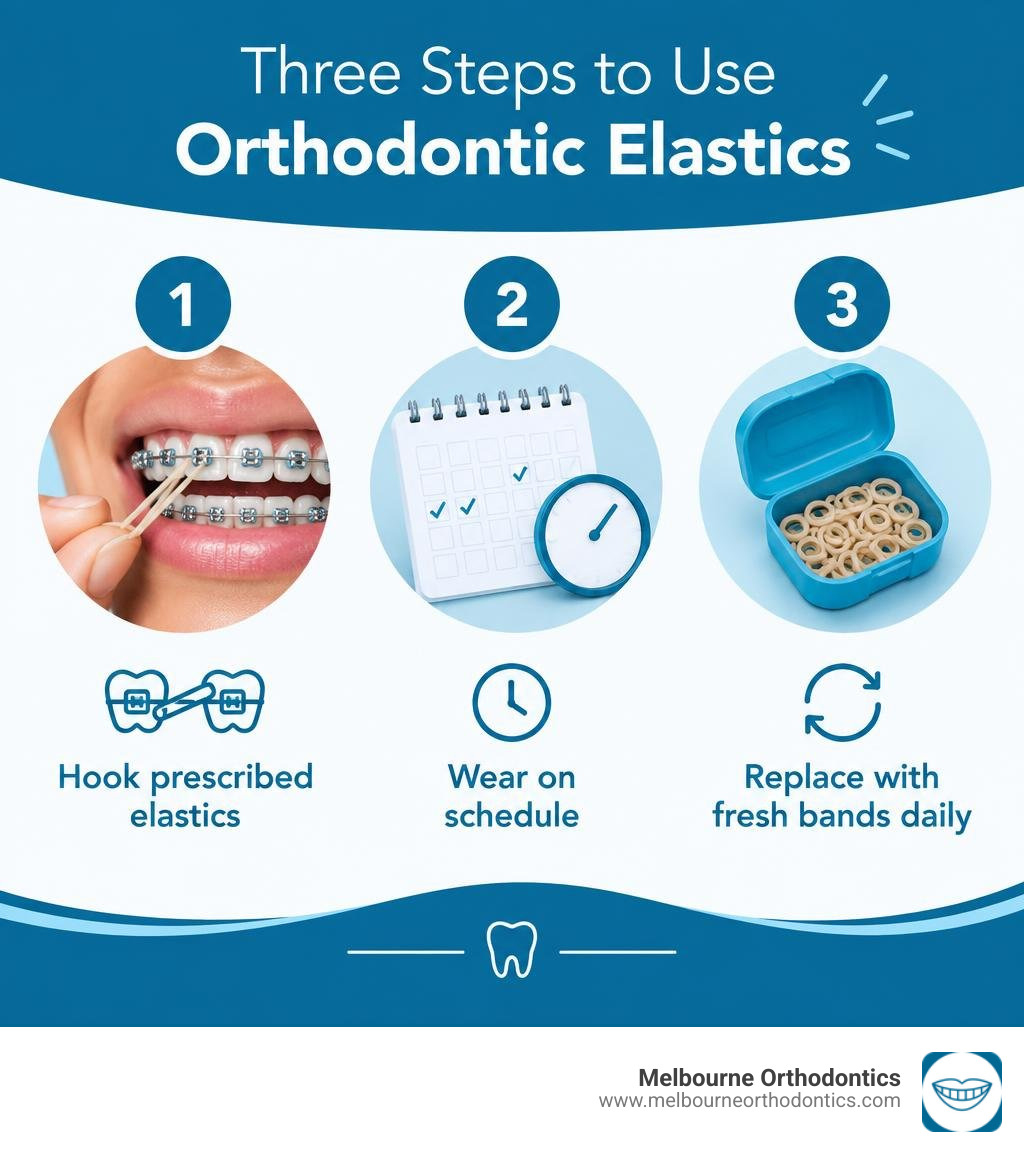
Orthodontic elastics are small, medical-grade rubber bands that connect your upper and lower teeth to improve how your bite fits together. To use them correctly: hook each band onto the exact points your orthodontist showed you, wear them for the prescribed schedule, and change your interarch elastics at least once a day. Consistent wear matters because fresh elastics provide steadier force, while saliva and stretching gradually reduce their strength.
These bands may be used with braces or clear aligners to help correct an overbite, underbite, crossbite, or small gaps in how the teeth meet. Never substitute household rubber bands or change the hook pattern on your own. The size, strength, and direction are chosen for your specific bite.
At Melbourne Orthodontics, serving Melbourne, Florida, and Indian Harbour Beach, Florida, our team uses orthodontic elastics as part of individualized plans designed to create a healthy, comfortable bite.
Key orthodontic elastics vocabulary:
What Are Orthodontic Elastics and How Do They Work?
Orthodontic brackets and archwires do an extraordinary job of aligning crooked teeth, closing gaps, and leveling the dental arches. However, archwires on their own operate within a single arch—either the top or the bottom. When it comes to correcting the relationship between your upper and lower jaws, we rely on intermaxillary traction delivered by specialized orthodontic appliances and elastics.

The underlying principle is basic physics and biomechanics:
- Vector forces: An elastic stretched between specific anchor points produces a continuous pull along a predictable diagonal, vertical, or horizontal path. This force coordinates the relationship between your maxillary (upper) and mandibular (lower) dental arches.
- Cellular bone remodeling: Sustained, gentle pressure stimulates cellular activity in the periodontal ligament. Specialized osteoclasts break down bone in the direction of compression, while osteoblasts generate new bone tissue behind the tension zone, safely moving teeth through the alveolar bone.
- Bite alignment: By altering the direction of pull, we can correct several complex malocclusions:
- Overbite / Class II: Elastics run from the upper canine area down to the lower first or second molars, gently guiding the upper anterior teeth back and bringing the lower dental arch forward.
- Underbite / Class III: Elastics connect from the lower anterior teeth (often canines) up to the upper molars, pulling the upper arch forward and nudging the lower teeth back into balance.
- Crossbite: Transverse elastics cross from the inside (tongue-side or palatal) of one arch to the outside (cheek-side or buccal) of the opposing arch to widen or narrow a dental arch.
- Open Bite: Vertical elastics placed in triangular, rectangular, or box configurations pull the upper and lower front teeth together so they overlap naturally when chewing and speaking.
- Midline Asymmetry: Unilateral or diagonal configurations help pull the central contact points of the upper and lower front teeth into matching harmony.
Latex vs. Non-Latex Orthodontic Elastics
Orthodontic elastics are manufactured under rigorous standards (such as ISO 21606) to ensure consistent elasticity and biological safety. Today, they are available in two primary materials: natural rubber latex and synthetic polymers (non-latex).
| Feature | Natural Rubber Latex | Synthetic Polyurethane (Non-Latex) |
|---|---|---|
| Material Source | Natural rubber tree sap | Medical-grade synthetic polymers |
| Elasticity & Stretch | Superior elasticity and elongation memory | Stable stretch with slightly stiffer initial feel |
| Force Decay Rate | Gradual force decrease over several hours | Predictable force delivery, requires timely changes |
| Allergy Risk | Contains natural proteins that can cause allergic reactions | 100% hypoallergenic and latex-free |
| Appearance | Slightly amber or translucent opaque | Clear or semi-translucent |
Latex elastics remain popular because they maintain a steady therapeutic force level across daily wear cycles. However, synthetic polyurethane alternatives provide an essential, safe option for anyone with known latex sensitivities, ensuring comfortable treatment without allergic reactions.
Ligatures vs. Interarch Rubber Bands
Patients often ask about the difference between the tiny colored rings placed directly on their brackets and the removable rubber bands they hook on themselves.
- Ligatures (O-rings): These tiny elastomeric rings wrap directly around each bracket wing to secure the archwire in place. To understand their specific function, read about why orthodontists put tiny rubber bands around braces brackets. They remain attached between your routine adjustment appointments.
- Interarch Elastics: These larger, stretchy bands are placed and removed by you. They connect the upper and lower jaws to shift the entire bite into proper alignment, requiring active daily participation and routine changes.
Explore our comprehensive braces treatment options to see how modern brackets, archwires, and elastics work in harmony.
How to Use Your Rubber Bands in 3 Easy Steps
Getting into a seamless routine with your elastics makes treatment straightforward. Discover why you have to wear your rubber bands to keep your smile transformation on schedule.
Step 1: Hooking and Placing Your Orthodontic Elastics
- Wash your hands thoroughly with warm water and soap before touching your mouth or hardware.
- Stand in front of a well-lit mirror so you can clearly see the designated attachment hooks.
- Attach the first anchor point: Using your fingertips or a small plastic elastic placer tool, hook the band onto the primary bracket peg (usually an upper canine hook or precision aligner slit).
- Stretch to the second anchor point: Gently stretch the band downward or backward to connect it to the designated lower hook, molar button, or bracket attachment.
- Verify placement: Confirm that the elastic is seated securely on both hooks and follows the exact geometric pattern prescribed by our team. Double-check that it does not slip off when you open your mouth.
Step 2: Following Your Daily Wear Schedule
To achieve steady biological tooth movement, elastics must be worn 20 to 22 hours per day during active correction.
- Remove them only when eating meals, brushing, and flossing.
- Inconsistent wear halts progress and causes teeth to shift back and forth, extending your overall time in treatment.
- Think of elastics like rolling a ball up a hill: consistent pressure moves it forward, while taking them out allows the ball to roll back down to where it started.
- Wearing them during sleep is essential because continuous overnight traction accounts for roughly a third of your daily corrective force.
Step 3: Changing and Maintaining Elastics Regularly
Orthodontic elastics lose their stretch quickly when exposed to saliva, warmth, and repeated jaw movement.
- Replace your elastics at least once every 24 hours (or 2 to 3 times daily as instructed) to maintain steady corrective forces.
- Discard used bands immediately upon removal rather than re-stretching old ones.
- Keep fresh packets in your backpack, purse, desk, or car so you never run out of supplies when you are away from home.
- Review our guide on all about orthodontic bands to master care for all your orthodontic hardware.
Managing Discomfort, Force Decay, and Side Effects
When you first begin wearing elastics, experiencing mild soreness or jaw fatigue is completely normal. Your facial muscles and supporting tooth tissues are adapting to new directional vectors. Here is what is happening behind the scenes and how to manage it:
- Optimal Force Levels: Clinical mechanics target light, continuous forces (around 70 to 120 grams per side). This gentle range encourages healthy bone remodeling and capillary blood flow without overloading the periodontal ligament.
- Understanding Force Decay: Studies show that elastics lose roughly 20% to 35% of their initial strength within the first several hours of wear due to mechanical fatigue and saliva. Changing them on schedule ensures they deliver the right amount of force throughout the day.
- Comfort Strategies:
- Eat softer foods (such as yogurt, smoothies, pasta, steamed vegetables, or eggs) during the first 2 to 3 days of a new elastic configuration.
- Apply a pea-sized dot of orthodontic wax over any bracket hooks that rub against your inner cheeks or lips.
- Over-the-counter pain relievers can help ease initial tenderness when approved by your doctor or orthodontist.
- Keep your elastics on instead of taking them off when soreness peaks; taking them off resets the adaptation cycle and prolongs discomfort.
- Protecting Tooth Roots: Wearing your elastics strictly as instructed protects root structures and prevents unwanted side effects like occlusal plane canting, root resorption, or uneven tooth tipping.
Frequently Asked Questions About Rubber Bands
How often should rubber bands be changed?
You should change your interarch elastics at least once a day, and ideally replace them after major meals or first thing in the morning and before bed. Because the oral environment causes elasticity loss within hours, fresh bands keep tooth movement predictable, continuous, and efficient.
Can you wear rubber bands with Invisalign aligners?
Yes! Clear aligners frequently use elastics to correct bite alignment. The bands hook directly into precision cuts in the aligner plastic or connect to small, tooth-colored composite buttons bonded securely to your teeth.
What should you do if a band breaks or causes soreness?
If a band snaps during the day, replace it immediately with a fresh elastic from your current packet. If you break or lose an elastic on one side, change both sides so force distribution stays balanced. If you run low on supplies, lose an attachment hook, or experience persistent discomfort that does not improve after a few days, contact our office right away so we can help.
Can I double up on rubber bands to finish treatment faster?
No, you should never double up on elastics or use stronger bands than prescribed. Applying excessive force does not speed up tooth movement; instead, it can damage the roots of your teeth, crush delicate blood vessels in the periodontal ligament, and actually slow down bone remodeling.
Conclusion
Mastering your rubber band routine is one of the most rewarding parts of orthodontic treatment. By hooking your bands accurately, following your daily wear schedule, and changing them regularly, you take an active role in building a well-aligned, healthy bite that lasts a lifetime.
At Melbourne Orthodontics, we provide personalized orthodontic care for children, teens, and adults across Melbourne, Florida, and Indian Harbour Beach, Florida. Learn more about what orthodontic elastics do for your bite and reach out to our team whenever you have questions about your smile journey!