How to Replace Your Lost or Broken Essix Retainer at Home
How to Replace a Lost or Broken Essix Retainer
If your Essix retainer is lost or broken, arrange a replacement as soon as you can. Ask your orthodontist whether a saved scan can be used. If not, you will need a new scan or impression. Some online labs offer at-home impression kits, but if your teeth have shifted or your old retainer no longer fits, get an orthodontic check before ordering. Never force a tight retainer onto your teeth or try to glue a broken one.
Essix retainers are clear trays that hold teeth in place after braces or aligners. This is just one type of retainer. Going without some type of retainer can allow teeth to move, so acting early gives you the best chance of keeping your results.
I’m Dr. Chad Reddick, the orthodontist at Melbourne Orthodontics. My specialized orthodontic training and work with retainer patients in the Melbourne area guide my approach to retainer replacement: check the fit, then choose the right way to make a new one.
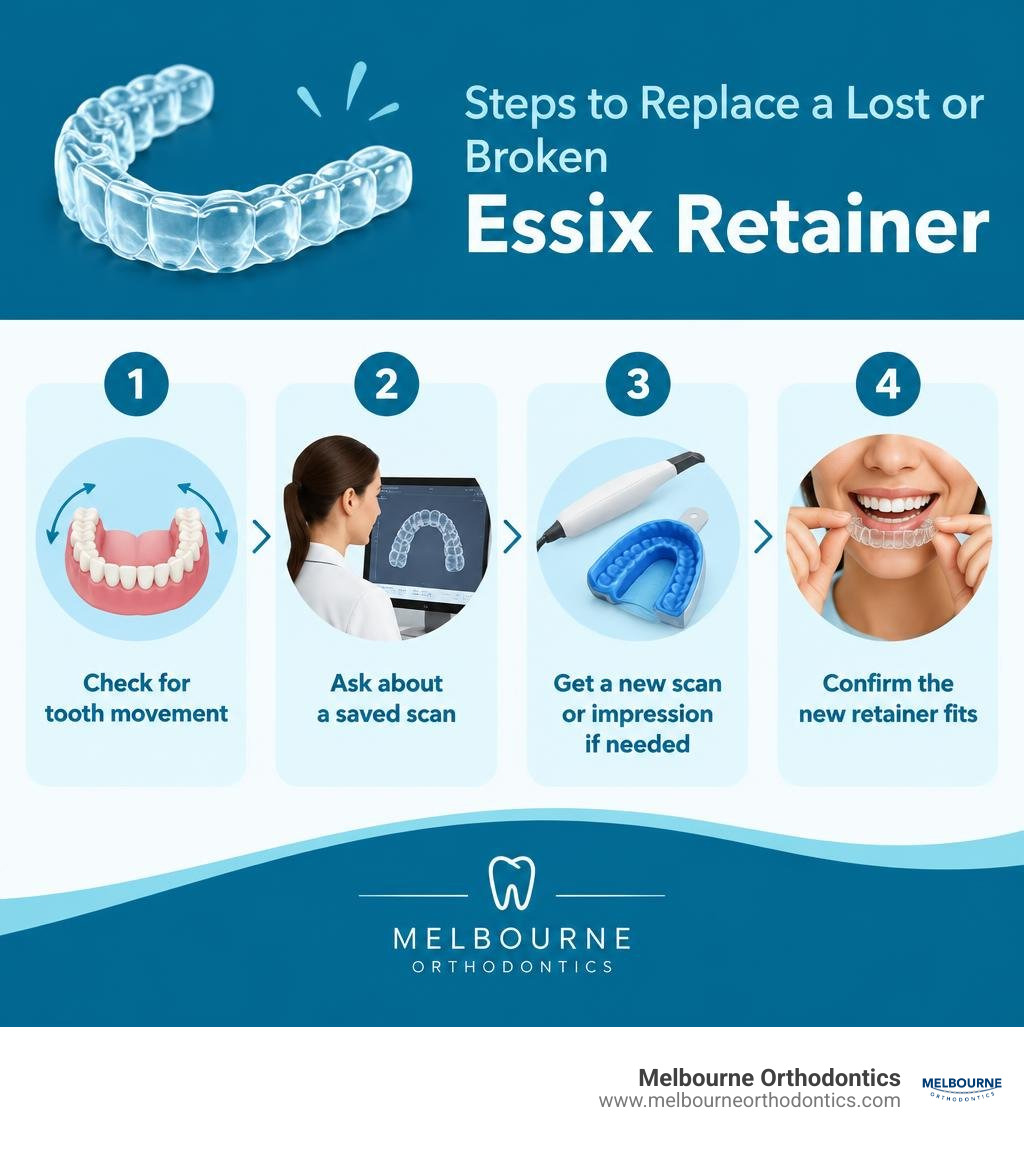
Understanding Essix Retainers and Why Quick Replacement Matters
An Essix retainer is a transparent, custom-molded dental appliance crafted from medical-grade, BPA-free PETG thermoplastic. Fabricated using high-heat vacuum-forming technology over a physical or 3D-printed model of your mouth, it snaps snugly over your dental arch to keep teeth locked into their ideal alignment.
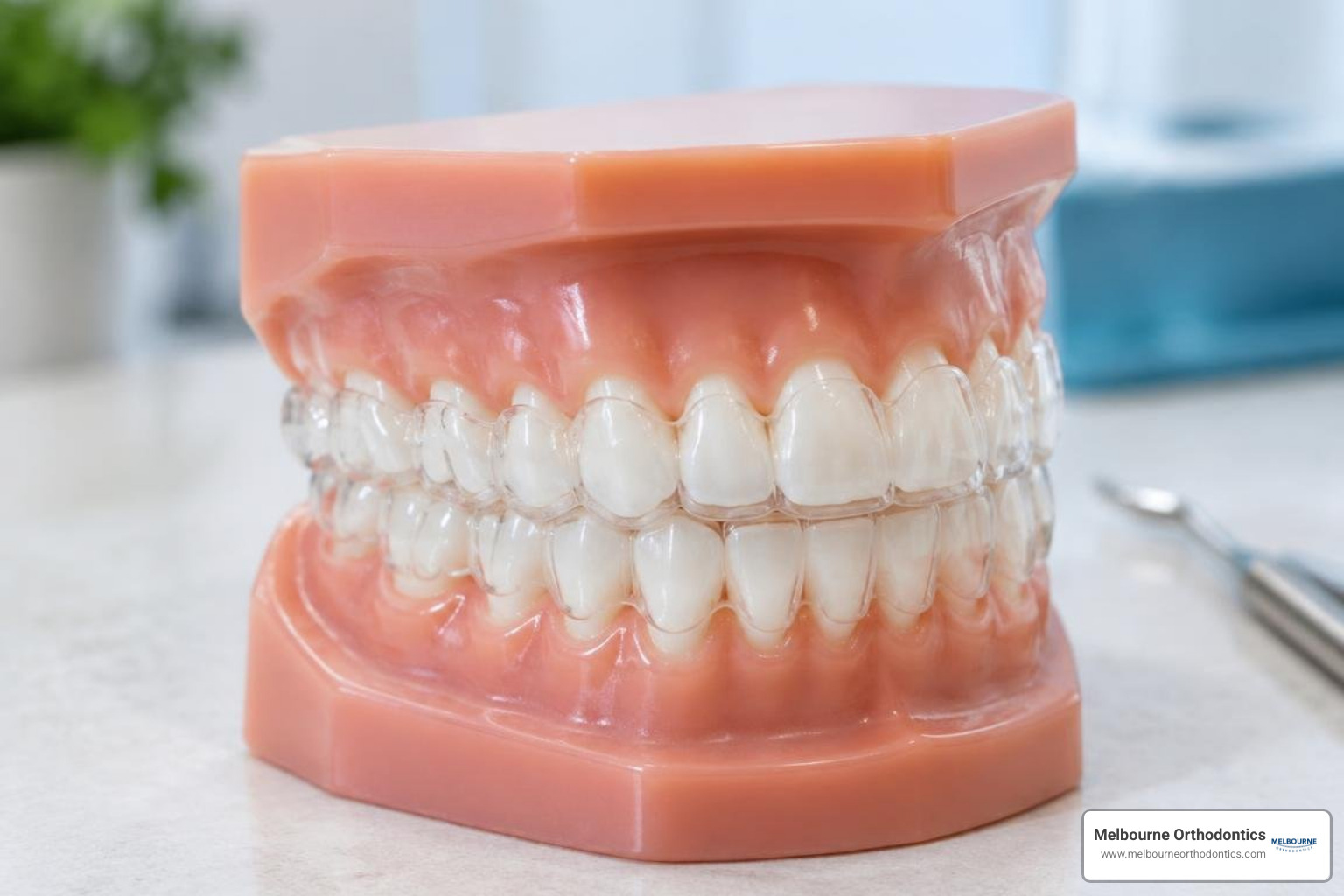
When patients finish braces or clear aligners, understanding why retainers are essential becomes the key to protecting their investment. The surrounding bone, periodontal ligaments, and soft tissues need extended time to remodel and stabilize. Without consistent retention, the elastic fibers in your gums naturally pull teeth back toward their original positions—a process known as orthodontic relapse. Because the material is lightweight and aesthetic, any sudden loss or crack requires immediate action to avoid irreversible shifting. Although esthetically pleasing, this is not always the best type of retainer for an individual.
Essix vs Hawley Retainers
Orthodontic retainers generally fall into different categories, and comparing different retainer styles helps clarify why patients often prefer clear trays over traditional designs.
Hawley retainers feature a molded acrylic base that rests on the palate or along the tongue-side gumline, connected to a metal labial bow wire that spans the front teeth. While traditional Hawley retainers are robust, adjustable, and can last 5 to 10 years or even longer, they are noticeably visible and can temporarily alter speech. Essix retainers, by contrast, cover the entire biting surface and facial side of the arch with crystal-clear plastic, making them virtually invisible in daily conversation.
| Feature | Essix Retainer | Hawley Retainer |
|---|---|---|
| Material | Clear PETG Thermoplastic | Acrylic base with stainless steel wire |
| Aesthetics | Discreet and virtually invisible | Visible metal bow across front teeth |
| Adjustability | Non-adjustable (requires replacement) | Adjustable by an orthodontist |
| Typical Lifespan | 1 to 3 years (often replaced every 12–24 months) | 5 to 10 years |
| Coverage | Full occlusal (covers biting surfaces) | Palatal/lingual acrylic with wire support |
When to Seek an Essix Retainer Replacement
Clear retainers do not last forever. Even with meticulous hygiene, everyday wear and mechanical stress eventually take a toll on the plastic. You should replace your retainer if you notice:
- Visible Cracks or Splits: Small hairline fractures can quickly widen, compromising the tension needed to hold teeth firmly.
- Loose or Warped Fit: If the tray rocks, slips off easily, or has been exposed to hot water, it will no longer maintain tooth position.
- Persistent Cloudiness or Biofilm: Deep microscopic scratches harbor bacterial colonies that cannot be removed by normal brushing.
- Wear from Clenching or Grinding: Heavy bite pressure flattens or punctures the occlusal surfaces over time.
Knowing what to do when appliances break prevents minor cosmetic damage from turning into full relapse. Taking action early is the single best strategy for preventing post-braces tooth movement.
Step-by-Step Guide to Ordering an Essix Retainer Replacement Online
Replacing an appliance from home has become straightforward thanks to digital dentistry and mail-order workflows. If you find yourself evaluating your steps after losing a retainer, you can either order through your existing orthodontic practice or utilize a direct-to-lab service. Using the mail order service should only be considered if there are no other options. Direct supervision by a dental professional to ensure proper design and fit would be best.

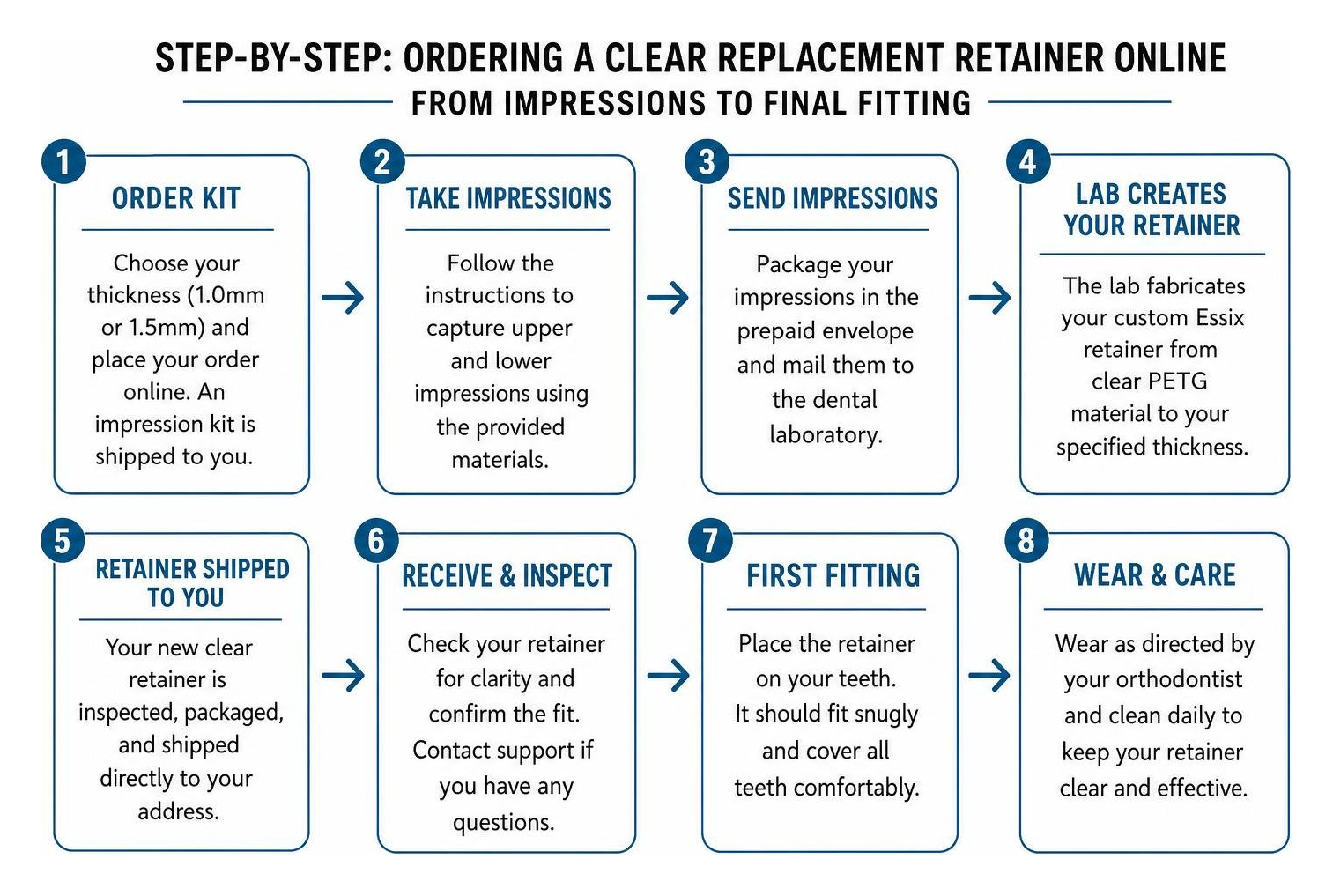
Choosing 1.0mm vs 1.5mm Material Thickness
Most custom Essix appliances are made from PETG plastic sheets in varying thicknesses:
- 1.0mm (Standard): The most common choice. It delivers a slim, ultra-discreet profile that is comfortable for daytime or nighttime use. It is ideal for patients with cosmetic dental work like composite bonding or veneers because it exerts gentle, balanced pressure.
- 1.5mm (Heavy-Duty): Recommended for moderate-to-severe teeth grinders (bruxism) or individuals with strong clenching habits. This thickness provides enhanced structural durability and higher resistance to biting punctures, though it feels slightly bulkier in the mouth. This should not be confused with a night guard or occlusal splint. These have different, more specialized properties for those with significant grinding habits.
Taking Accurate At-Home Dental Impressions or Submitting 3D Scans
If your provider or lab does not have a current digital file on record, you will need to create a physical or digital record of your teeth:
- Digital STL Files: If your orthodontist captured a 3D intraoral scan at the end of your treatment, you can often request the digital .STL file and email or upload it directly to the fabrication lab.
- At-Home Putty Impressions: If taking a manual impression, thoroughly mix the two-part putty until it reaches a uniform color, place it evenly into the plastic arch tray, and press firmly over your dental arch in one smooth motion. Ensure the putty covers your teeth up to the gumline and second molars. Allow it to set completely before gently easing it out.
Taking time during this step prevents handling ill-fitting dental appliances later on.
Turnaround Time and What to Expect
Once the laboratory receives your digital scan or physical impressions, technicians inspect the models for accuracy. The selected plastic sheet is heated, vacuum-formed over the dental model, carefully trimmed with scalloped or straight edges, and polished.
Standard turnaround time typically spans several business days for manufacturing, followed by tracked postal shipping directly to your door. When your new appliance arrives, try it on right away to ensure it snaps cleanly into place over all teeth without pinching the gums, helping you focus on maintaining long-term orthodontic stability.
Essix Retainer Replacement Costs, Insurance, and Billing Codes
Managing the financial side of retainer upkeep starts with keeping your appliance protected—such as avoiding napkins at restaurants and protecting appliances from pets who love to chew on dental plastic.
Comparing In-Office vs At-Home Replacement Costs
The total cost to replace an Essix retainer depends heavily on the fabrication route, whether single or dual arches are ordered, and whether existing 3D digital records are available.
| Replacement Route | Typical Provider Scope | Delivery / Turnaround | Key Advantages |
|---|---|---|---|
| In-Office Orthodontic Practice | Orthodontist-supervised evaluation, professional 3D scan, in-house lab or certified dental lab | Rapid local turnaround or immediate fitting | Professional fit verification; checks for tooth movement or bite shifts |
| Direct-to-Consumer / Online Lab | Mail-order dental lab using self-impressions or emailed STL files | 1 to 3 weeks including transit | Convenient home ordering process |
Insurance, Medicaid, and Dental Billing Codes (D8703 / D8704)
If you plan to file for insurance reimbursement or utilize a Health Savings Account (HSA) or Flexible Spending Account (FSA), having the correct Current Dental Terminology (CDT) codes is essential:
- D8680 (Orthodontic Retention): Typically used for the initial post-treatment retention phase, covering fabrication and placement.
- D8703 (Replacement of Lost or Broken Retainer – Maxillary): The primary code for replacing an upper retainer.
- D8704 (Replacement of Lost or Broken Retainer – Mandibular): The primary code for replacing a lower retainer.
(Note: Older claims may occasionally use D8692, though D8703 and D8704 are the modern arch-specific standards).
Dental insurance plans vary significantly regarding replacement coverage. Some policies cover one replacement per arch within a 12-month period, while others treat replacements as out-of-pocket elective maintenance once the active orthodontic benefit is exhausted. For eligible Medicaid recipients under age 20, replacement retainers may be covered under state-specific guidelines when deemed medically necessary. Always obtain a detailed itemized receipt with the appropriate CDT codes from your provider to submit directly to your plan administrator.
How to Care for Your New Retainer to Maximize Longevity
Caring for clear retainers properly extends their functional lifespan and keeps your smile healthy:
- Rinse Immediately: Whenever you take your retainer out, rinse it with cool or lukewarm water to prevent saliva and plaque from drying on the plastic.
- Follow Proper Cleaning Steps: Brush gently using a soft-bristled toothbrush and clear, mild liquid soap. Master daily cleaning protocols and avoid regular abrasive toothpaste, which creates micro-scratches that trap bacteria and cloud the material.
- Use Specialized Soaks or Ultrasonics: Incorporate effervescent retainer cleaning tablets or a gentle ultrasonic cleaner a few times each week to maintain routine appliance hygiene.
- Never Use Boiling Water: High heat warps thermoplastic in seconds. Keep your retainers away from hot car dashboards, dishwashers, and boiling water.
- Always Use a Hard Case: By avoiding damaging cleaning habits and leaving the case open for 10 minutes to dry before snapping it shut, you stop fungal and bacterial growth in its tracks.
- Maintain Complete Appliance Routines: For patients in active dual-phase or retention stages with supplemental elastics, patients prescribed interarch elastics are recommended to change them at least once a day to ensure consistent, effective elasticity.
Frequently Asked Questions About Essix Retainers
How long do Essix retainers typically last before needing replacement?
A well-maintained Essix retainer generally lasts 12 to 24 months, with some lasting up to 3 years depending on care and bite pressure. Patients with bruxism (teeth grinding) may need to replace their trays every 9 to 12 months as the occlusal surfaces wear down. Understanding these long-term retention realities ensures you plan ahead before your appliance cracks or loses shape.
How quickly do teeth shift after losing an Essix retainer?
Teeth can begin shifting measurably within the first 72 hours of going without an appliance. The periodontal ligaments retain elastic memory, making prompt action vital. If you experience a brief delay, read our advice on restarting wear after a gap and never force a tray that causes acute pain.
Can I get an Essix retainer replacement with a missing tooth pontic?
Yes. An Essix retainer can incorporate a custom, shade-matched artificial tooth (pontic) directly into the clear tray. This serves as a cosmetic bridge and space maintainer, preventing adjacent teeth from tipping into the gap while you wait for a permanent dental implant or bridge.
Conclusion
A healthy, beautifully aligned smile is a lifelong asset, and keeping it intact requires proactive oral care. Whether you are replacing a cracked tray, ordering a backup set, or updating your retention plan, taking prompt action keeps your teeth securely in place. At Melbourne Orthodontics, we work closely with families throughout Melbourne and Indian Harbour Beach to deliver personalized orthodontic solutions. If you need assistance replacing a lost or damaged appliance, explore our options for custom retainers or contact our team to schedule an evaluation today.