Speeding Up Your Smile: Realistic Expectations for Braces Timeline
A Realistic Orthodontic Treatment Timeline
Most orthodontic treatment takes 12 to 36 months. Mild crowding or small gaps may improve in as little as 6 to 12 months, while complex bite problems, severe rotations, or cases involving extractions can take 24 to 36 months. Most braces cases fall around 18 to 30 months.
Your personal orthodontic treatment timeline depends less on a single average and more on your starting point, the tooth movements needed, and how closely you follow the plan. Braces and clear aligners can both create excellent results; the better option is the one that can move your teeth efficiently and that you can use consistently.
You can help keep treatment on track by:
- Wearing clear aligners for 20 to 22 hours each day, if prescribed
- Wearing rubber bands exactly as directed and changing interarch elastics at least once a day
- Keeping every adjustment visit
- Avoiding foods and habits that break brackets or appliances
- Brushing and flossing carefully to prevent dental problems that can pause treatment
At Melbourne Orthodontics, we help patients in Melbourne, Florida and Indian Harbour Beach, Florida understand the milestones behind their orthodontic treatment timeline before active treatment begins. Our team provides specialized orthodontic care, creating individualized plans for children, teens, and adults based on healthy function, realistic timing, and lasting results.
Know your orthodontic treatment timeline terms:
Key Factors That Shape Your Orthodontic Treatment Timeline
While peer-reviewed orthodontic literature demonstrates that fixed appliance therapies generally range between 14 and 33 months, every smile requires an individual biological pathway. Moving teeth is not simply mechanical manipulation; it is a delicate biological process known as bone remodeling.
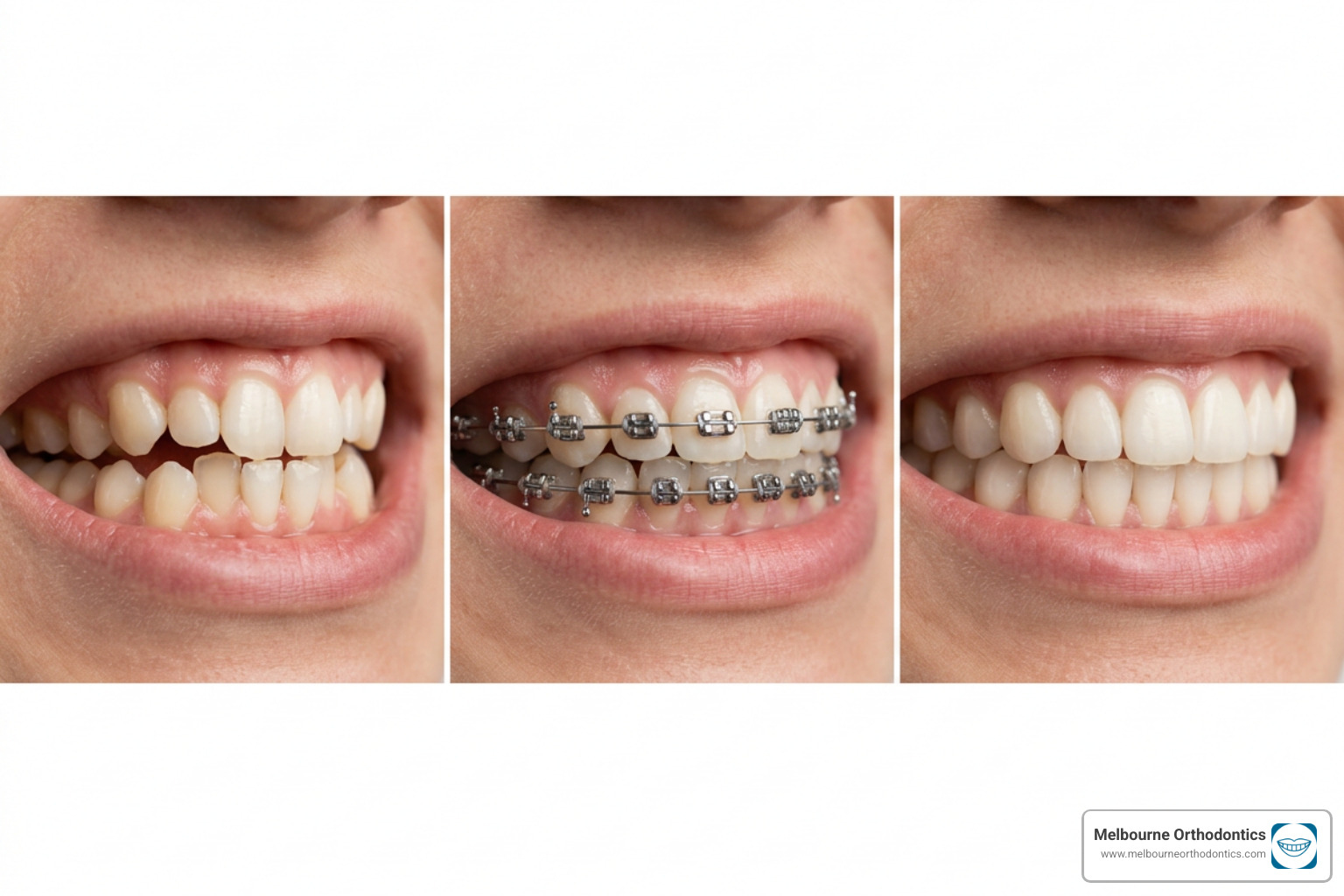
When an orthodontic appliance applies light, continuous pressure to a tooth, the periodontal ligament surrounding the root experiences compression on one side and tension on the other. Specialized cells called osteoclasts break down bone tissue in the path of the movement, while osteoblasts rebuild new bone behind it. Pushing teeth faster than this cellular turnover allows can lead to root resorption or unstable results. Understanding how long orthodontic treatment takes requires looking closely at what affects the duration of orthodontic treatment on an anatomical level.
Case Complexity and the Orthodontic Treatment Timeline
The starting position of your teeth and jaws serves as the primary baseline for your schedule. Mild alignment issues, such as slight anterior crowding or minor spacing without bite discrepancies, often wrap up in 6 to 12 months.
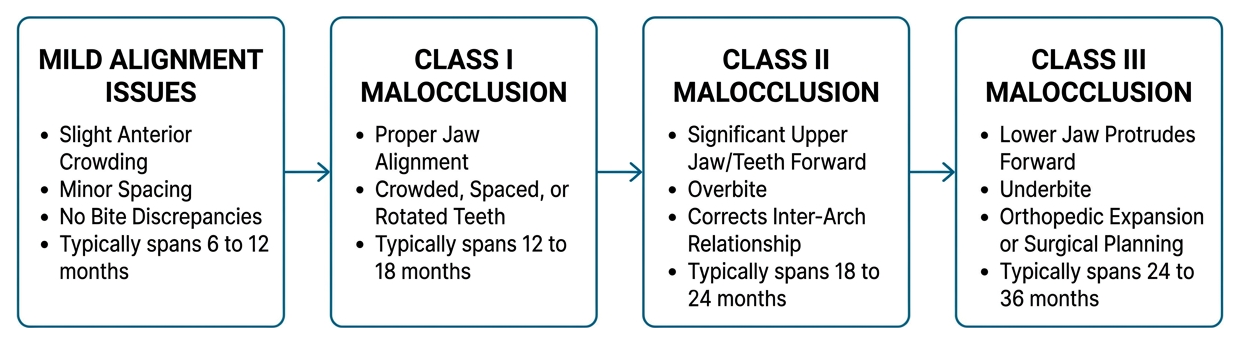
However, when malocclusions involve skeletal discrepancies, the timeline expands:
- Class I Malocclusion: The jaws align properly, but teeth are crowded, spaced, or rotated. Treatment typically spans 12 to 18 months.
- Class II Malocclusion: The upper jaw or teeth sit significantly forward relative to the lower jaw (overbite). Correcting the inter-arch relationship requires coordinated force over 18 to 24 months.
- Class III Malocclusion: The lower jaw protrudes forward (underbite). Guiding the dental arches into proper occlusion frequently takes 24 to 36 months, especially if combined with orthopedic expansion or orthognathic surgical planning.
- Impacted Teeth & Extractions: Moving impacted canines into the archwire line or closing extraction spaces securely adds necessary calendar months to allow proper root paralleling.
Gaining clarity by understanding your orthodontic timeframe ensures realistic expectations from your first scan.
Appliance Choice: Braces vs. Clear Aligners
Both fixed appliances and removable aligners are capable instruments, but their movement mechanics differ significantly. We evaluate which modality matches the physical movement requirements of your specific anatomy.
| Appliance Type | Average Duration | Typical Adjustment Interval | Best Clinical Use Cases |
|---|---|---|---|
| Traditional Metal Braces | 18 – 30 Months | Every 4 to 8 Weeks | Severe crowding, large rotations, complex bite corrections, vertical movements |
| Ceramic Braces | 18 – 30 Months | Every 4 to 8 Weeks | Moderate to severe corrections where cosmetic discretion is desired |
| Clear Aligners | 6 – 18 Months (Mild/Mod) / 18 – 24+ Months (Complex) | Every 6 to 10 Weeks | Mild-to-moderate crowding, spacing, relapse cases, patients with high compliance |
Exploring why treatment timelines vary across patients clarifies how selecting the right tool dictates treatment efficiency.
Age and Skeletal Maturity
Age plays a distinctive role in the rate of tooth movement. In growing children and adolescents, the maxillary sutures are still open and alveolar bone is less dense, allowing for efficient remodeling and orthopedic jaw modification.
In adults, the craniofacial bones have fully fused and bone density is considerably higher. While adult teeth move using the exact same biological mechanisms, the initial cellular response can be slightly slower. Adults also frequently present with restorations, prior periodontal changes, or missing teeth that require tailored mechanics. Learning why braces treatment times differ across age groups helps older patients appreciate the physiological care taken to preserve root health during alignment.
Phases of Orthodontic Care: From Planning to Debonding
A successful orthodontic journey follows a structured series of milestones designed to systematically move teeth from diagnosis to lasting retention.
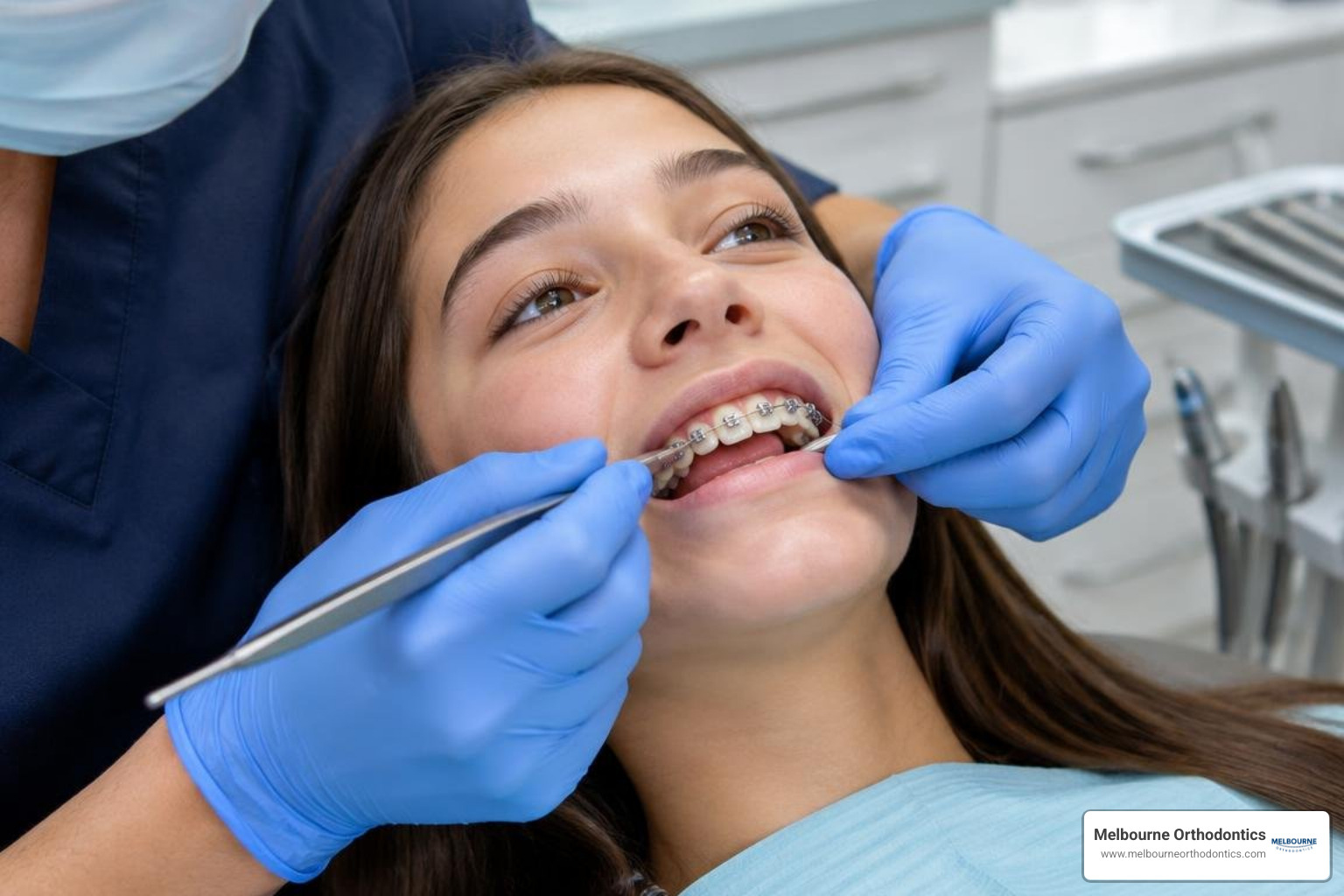
- Initial Records & 3D Imaging: Comprehensive diagnostic records are captured, including high-resolution digital intraoral scans, digital panorex, and cephalometric X-rays.
- Personalized Treatment Planning: Digital modeling maps out the precise sequence of tooth movement, calculating force vectors and anchorage requirements.
- Appliance Placement: Brackets are bonded to enamel or initial clear aligner series and attachments are placed.
- Early Alignment & Leveling: Initial flexible archwires (such as nickel-titanium) or beginning aligner trays untangle crowded teeth and bring crowns into an even plane.
- Major Tooth Movement & Bite Correction: Stiffer stainless steel wires, interarch elastics, or power chains engage to close spaces, address rotations, and adjust bite relationships.
- Finishing & Detailing: Fine-tuning bends or aligner refinements perfect tooth inclinations, aesthetic margins, and intercuspation.
- Debonding: Fixed brackets are removed, adhesive is polished away, and final records are taken.
Active Movement and Adjustment Schedule
During the active movement phase, periodic visits allow us to calibrate forces, evaluate tissue responses, and progress through wire sequences. For traditional or ceramic braces, appointments take place every 4 to 8 weeks. For clear aligners, progress evaluations occur roughly every 6 to 10 weeks, often paired with scheduled tray batch handoffs to keep movement progressing steadily.
The Retention Phase: Protecting Your Orthodontic Treatment Timeline Investment
The removal of your braces or completion of your final aligner tray marks the conclusion of active movement—but not the end of your orthodontic timeline. Immediately following movement, the surrounding alveolar bone and gingival fibers require time to reorganize and remineralize around the new root positions.
Without diligent retention, the natural elasticity of the periodontal ligament can pull teeth back toward their original positions.
- Clear Essix Retainers: Custom-thermoformed clear trays worn over the dental arch, offering discreet stabilization.
- Hawley Retainers: Acrylic bases paired with an adaptable metal wire, ideal for long-term durability and minor settle adjustments.
- Bonded Fixed Retainers: A discreet, customized wire bonded behind the anterior teeth, providing continuous retention for high-relapse areas.
Patients typically wear removable retainers full-time for the first 6 months post-treatment, transitioning to nightly-for-life wear to preserve their aligned smile indefinitely.
How Patients Can Actively Shorten Treatment Time
While you cannot rush biological bone remodeling, the single largest factor within a patient’s control is day-to-day compliance. Implementing proven tips for getting your braces off sooner prevents accidental delays from extending your active schedule.
Daily Compliance and Elastic Wear Protocol
Small lapses in daily appliance wear create cumulative delays:
- Aligner Wear Schedule: Keep clear aligners seated for 20 to 22 hours every single day. Leaving trays out for extended periods allows teeth to regress, leading to “tracking errors” that necessitate new scans and delay progress by weeks or months.
- Interarch Elastics: If prescribed rubber bands, wear them precisely according to directions. We recommend that patients change their interarch elastics at least once a day to maintain consistent, active force levels, as elasticity degrades with use.
- Dietary Precautions: Hard, crunchy, sticky, or chewy foods can shear brackets off enamel or bend archwires. Every broken bracket halts active movement on that tooth until repaired, easily adding an extra month to your total timeline.
- Oral Hygiene: Plaque accumulation causes gingivitis and swollen tissue. Severe inflammation slows tooth movement and may force us to pause active mechanics to address periodontal health.
Safe Acceleration and Troubleshooting Stalled Cases
Patients often ask about acceleration technologies, such as micro-osteoperforation, high-frequency vibration accessories, or specialized archwire materials like SmartArch technology. While advanced materials can optimize force distribution and reduce early alignment stages by up to 25%, teeth still have a physiological speed limit governed by vascular flow and bone remodeling.
If your treatment appears to stall:
- Check Appliance Tracking: Verify that your aligners seat completely without air gaps, or that no loose brackets are sliding along the wire.
- Confirm Elastic Discipline: Inconsistent band wear creates a “tug-of-war” effect where teeth rock back and forth rather than moving forward.
- Attend Every Visit: Missing an adjustment appointment pauses the transition to the next wire or tray progression, extending treatment time automatically.
Frequently Asked Questions About Orthodontic Timelines
Can clear aligners straighten teeth faster than traditional braces?
For mild-to-moderate alignment issues, clear aligners can sometimes achieve final results faster than fixed braces—often finishing within 6 to 18 months. However, for complex root uprighting, severe skeletal bite discrepancies, or large extractions, traditional braces often offer greater multi-directional force control, making them the more efficient choice.
What causes orthodontic treatment to take longer than estimated?
The most frequent culprits behind prolonged timelines are missed adjustment appointments, broken brackets, incomplete aligner wear time, poor elastic compliance, and poor oral hygiene. Individual biological factors, such as unusually dense alveolar bone or sluggish cellular turnover, can also extend your estimated timeline.
How often are orthodontic adjustment appointments scheduled?
Patients with traditional or ceramic braces generally visit the clinic every 4 to 8 weeks for wire adjustments, elastic changes, and progress checks. Clear aligner patients are typically seen every 6 to 10 weeks to monitor tooth tracking and pick up their next series of custom trays.
Conclusion
Achieving a healthy, aligned smile is a collaborative investment between biological science, clinical expertise, and daily patient habits. While the average orthodontic treatment timeline spans between 12 and 36 months, keeping appliances intact, wearing elastics as directed, and attending every scheduled check-in ensures your journey completes as efficiently and smoothly as possible.
At Melbourne Orthodontics, we take pride in delivering comprehensive, modern orthodontic solutions designed around your lifestyle. Whether you are considering traditional braces or clear aligners, we invite you to explore our comprehensive orthodontic treatment options and begin your journey toward a lifetime of confident, radiant smiles.